Ask What Is Available in Korean: Subtitles, Versions, Refills and Ingredients
By Korean ESY · Editorial standards
October 18, 2026
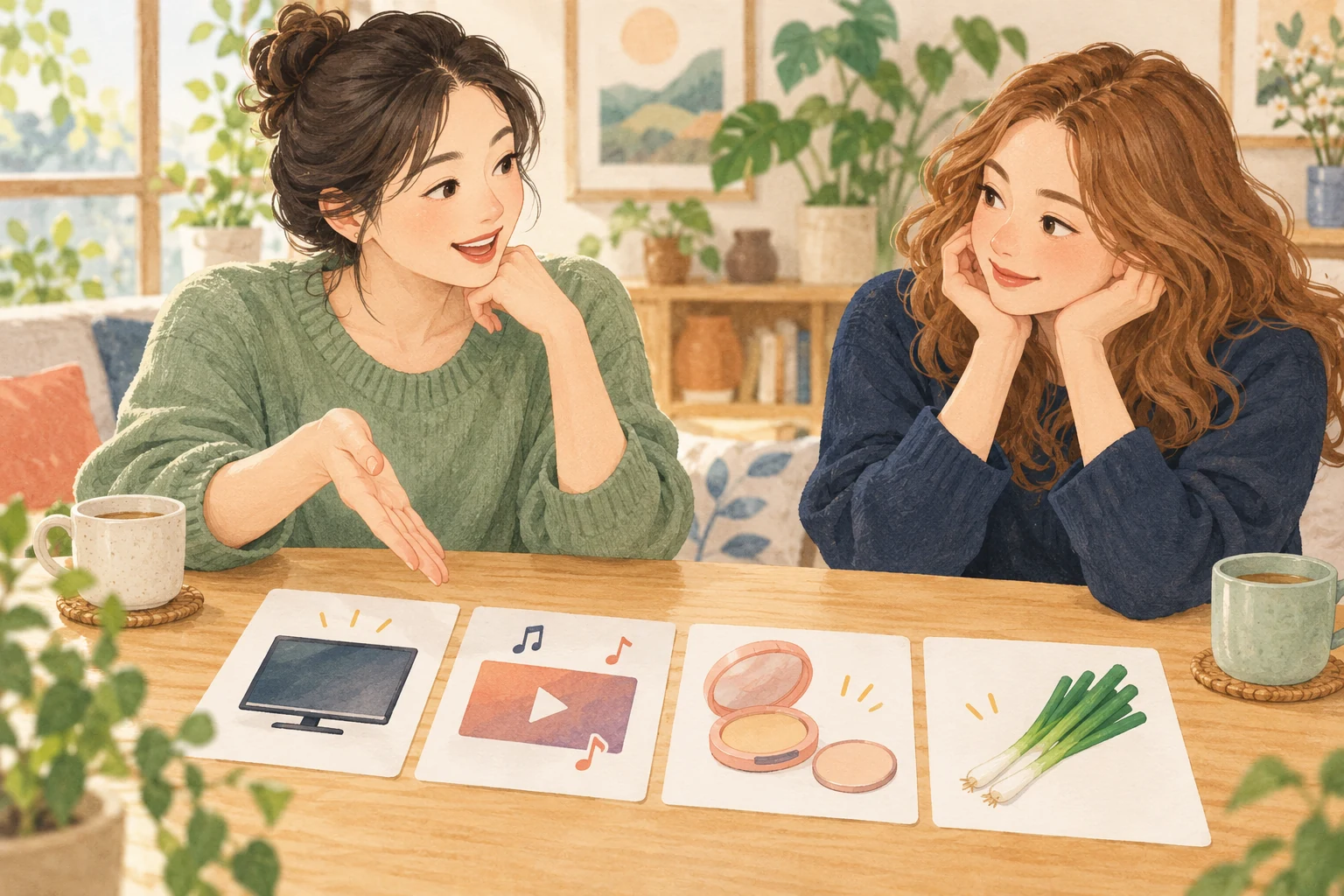
A subtitle option, a different music video, a refill and an ingredient all invite the same practical question: is it available in the context I mean? In Korean, 있어요? can help you ask that question. A useful answer depends on naming the thing clearly and checking the right place.
This lesson links four KoreanESY culture and food articles published this week. You will make a small availability worksheet with three possible answers: yes, no, or not checked yet. The conversations and scenarios are original teaching examples with fictional speakers. They do not report a real product purchase, viewing experience or cooking test.
This week’s four connected articles
- K-drama audio and subtitle choice guide — KES-2026-029, published October 12, 2026.
- K-pop video version bookmark guide — KES-2026-030, published October 14, 2026.
- K-beauty cushion refill versus set — KES-2026-031, published October 16, 2026.
- Haemul Pajeon for Two — KES-2026-037, published October 17, 2026.
Start with a thing and a context
있다 can describe something existing or being present; 없다 expresses its absence. In the everyday polite forms used here, ask 있어요? and answer 있어요 or 없어요. The written question mark distinguishes the question from the statement; in conversation, context and intonation help make the question clear.
For example, 영어 자막이 있어요? means “Are there English subtitles?” If both speakers are looking at the same title, that may be enough. If they are looking at different titles, name the drama first. A vague question can receive a perfectly reasonable answer about the wrong thing.
Keep the scope alongside the question: this title in this app, this song on this channel, this exact product at this seller, or this ingredient at home. “Available somewhere” and “available in the place I am checking” are different findings.
1. Ask about subtitles for a particular drama
이 드라마에 영어 자막이 있어요? — Does this drama have English subtitles?
A: 이 드라마에 영어 자막이 있어요? — Does this drama have English subtitles? B: 아직 확인하지 않았어요. — I have not checked yet.
The phrase 이 드라마에 sets the drama as the context; 영어 자막 names the option. Before answering yes, inspect the language options for the exact title you plan to watch. Netflix explains that language availability can vary with factors such as location, profile settings, title and device. A subtitle option seen by somebody else does not settle your own check.
Use the audio-and-subtitle guide below to decide which setting you want to investigate. The Korean sentence asks about availability; it does not say the translation is accurate, the subtitles are comfortable to read, or you have already watched the show.
2. Ask whether there is another kind of music video
이 노래의 공연 영상도 있어요? — Is there also a performance video of this song?
A: 이 노래의 공연 영상도 있어요? — Is there also a performance video of this song? B: 아직 확인하지 않았어요. — I have not checked yet.
Here, “also” is the job of 도 in 영상도. For practice, notice the sequence 공연 영상도 있어요? rather than trying to add another word for “also.” The question assumes you have been discussing one version and want to check for a performance video too.
Identify the song and channel before searching. The video-version guide helps you distinguish what an upload claims to be. Do not answer yes because a fan edit exists if the question was specifically about an official performance upload. Record the uploader and version you actually checked.
3. Ask about a refill without assuming what a set contains
이 제품은 리필도 있어요? — Is a refill also available for this product?
This is a useful question about a product range or seller’s offering. It is not the same as asking whether the pack in front of you includes a refill. A standalone refill can exist even when a particular set contains only a compact.
The cushion guide explains why you should compare the exact product name and the listing contents. Use the question with the actual product identified, then verify compatibility and the seller’s description separately. Similar packaging is not enough to establish that one refill fits another case.
For the worksheet, write the scope explicitly: “compatible refill offered in this seller’s current listing.” If the page only says that the selected pack contains no refill, record that narrower fact. Do not turn it into a conclusion that no refill exists anywhere.
4. Check an ingredient at home
집에 쪽파가 있어요? — Do we have scallions at home?
A: 집에 쪽파가 있어요? — Do we have scallions at home? B: 네, 있어요. — Yes, we do. This answer belongs to a fictional scenario in which the speaker has checked the kitchen.
집에 means “at home” in this question. Korean 쪽파 is the ingredient named in the connected haemul-pajeon article; use that article’s ingredient and substitution guidance when planning the dish. Knowing that an ingredient is present does not tell you whether there is enough of it or whether it is still suitable to use.
After checking availability, compare the quantity you have with the recipe. Keep the language exercise separate from food-safety or allergy decisions: this question does not confirm that a prepared dish is free of an allergen.
Keep the conversation polite
The examples use the 해요 style, an everyday polite way of speaking. Keep the final 요 when practising with an adult you do not know well, such as a new classmate. The National Institute of Korean Language explains that -어요 can appear in statements and questions, among other sentence types; the ending alone does not make every sentence a question.
These examples ask about things. Referring respectfully to a person can require different honorific wording, so do not extend every object example directly to a teacher or older person. Workplace and formal situations may also call for other speech levels.
You do not need to say yes to keep the exchange friendly. 네, 있어요 means “Yes, there is/are” in these contexts; 아니요, 없어요 means “No, there is/are not.” 아직 확인하지 않았어요 means “I have not checked yet.” Use that third answer when the evidence is missing.
Make a five-field availability worksheet
For each situation, write five fields: exact item; place or context; Korean question; answer; how and when checked. This is an original practice tool, not a record of checks conducted by KoreanESY.
Example blank row: Item — English subtitles for [title]. Context — [app, device and location]. Question — 이 드라마에 영어 자막이 있어요? Answer — [yes / no / not checked]. Evidence — [what you inspected and when].
Fill a second row for a music-video version, a third for the exact refill and a fourth for an ingredient at home. Leave the evidence field blank until you really check. An empty field is a reminder to investigate, not a reason to guess.
A short practice, with answers
Choose 네, 있어요; 아니요, 없어요; or 아직 확인하지 않았어요 for each fictional situation. A: You have opened the exact title’s language menu and it lists English subtitles. B: You have checked the kitchen and there are no 쪽파 at home. C: Nobody has checked whether a performance video exists.
Answers: A — 네, 있어요. B — 아니요, 없어요. C — 아직 확인하지 않았어요. B is about the checked home inventory; it makes no claim about shops or tomorrow’s ingredients.
One more check: a cosmetic set listing says “refill not included.” Can you conclude that a compatible refill is unavailable separately? No. The listing answers a pack-contents question, while the separate-refill question still needs its own check.
Finish by choosing one real context and writing a question you can answer honestly. Name the item, check the relevant place, and record the result. The useful habit is connecting a simple sentence to a precise observation.
References
- National Institute of Korean Language: 있다² — Existence sense and contrast with 없다; checked October 17, 2026.
- National Institute of Korean Language: 있어요/있나요 question endings — Official answer dated November 4, 2025; answer body read October 17, 2026. Supports the 해요 ending and sentence-type distinction.
- Netflix: subtitle or audio language availability — Availability limitations only; checked October 17, 2026.
- K-drama audio and subtitle choice guide — KES-2026-029, published October 12, 2026. Connected reading; publication evidence reused October 17.
- K-pop video version bookmark guide — KES-2026-030, published October 14, 2026. Connected reading; publication evidence reused October 17.
- K-beauty cushion refill versus set — KES-2026-031, published October 16, 2026. Connected reading; publication evidence reused October 17.
- Haemul Pajeon for Two — KES-2026-037, published October 17, 2026. Connected reading; publication evidence reused October 17.
Keep going
Ready for a guided next step?
The learning path walks you through the key ideas, one comfortable step at a time.