Haemul Pajeon for Two: A Shrimp and Scallion Pancake Guide
By Korean ESY · Editorial standards
October 17, 2026
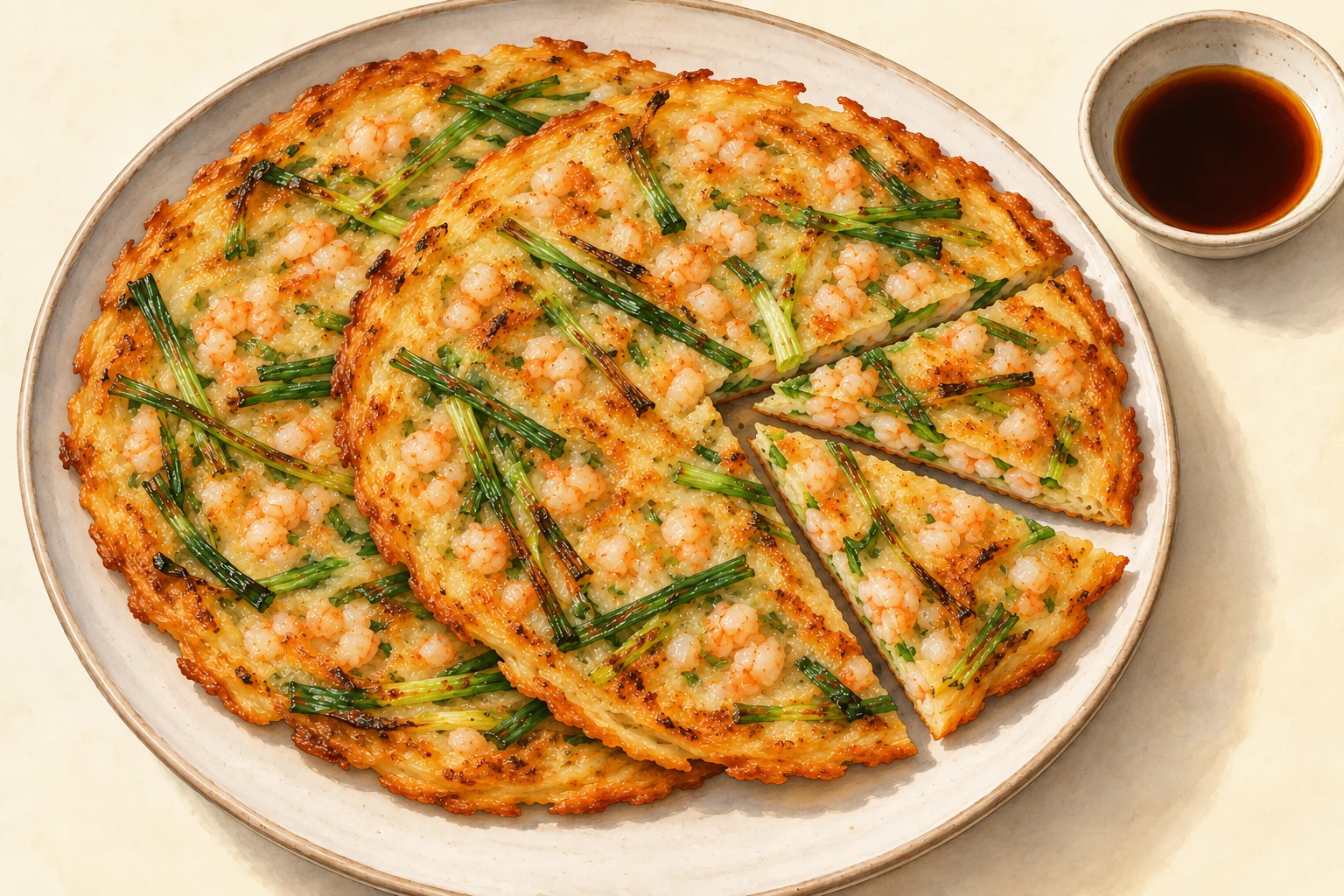
Haemul pajeon (해물파전) is a savory Korean scallion pancake with seafood. This version makes two small pancakes with chopped shrimp, a plain flour batter and a simple soy dipping sauce. The practical aim is a thin pancake that you can turn without scattering the filling.
This is a cultural cooking guide, not a report of a newly verified food trend. Our dated starting point is Hyosun’s Korean Bapsang article, published December 9, 2019 and updated March 8, 2021, revisited October 16, 2026. It explains pajeon’s scallion-and-seafood combination and its rainy-day association. That older context does not establish current popularity. Our measured adaptation below has not been kitchen-tested by KoreanESY; the images are AI illustrations, not cooking-test photographs.
Recipe card
Yield: two pancakes, about 20 cm / 8 inches across; two light portions. Estimated time: 15 minutes preparation plus 20 minutes cooking, about 35 minutes total, excluding thawing. Cook the pancakes one after the other. Skill: beginner with a careful flip. Heat: no chili in this version. Equipment: kitchen scale, measuring spoons, mixing bowl, nonstick skillet at least 24 cm across, broad spatula and food thermometer.
The quantities are our proposed gram-and-milliliter formulation, not a tested conversion of the source’s cup measures. Use the batter cue and seafood temperature below. A tablespoon here means 15 mL and a teaspoon 5 mL; dry grams are not volume conversions.
Ingredients
| Ingredient | Exact recipe amount and state | Buying note / role |
|---|---|---|
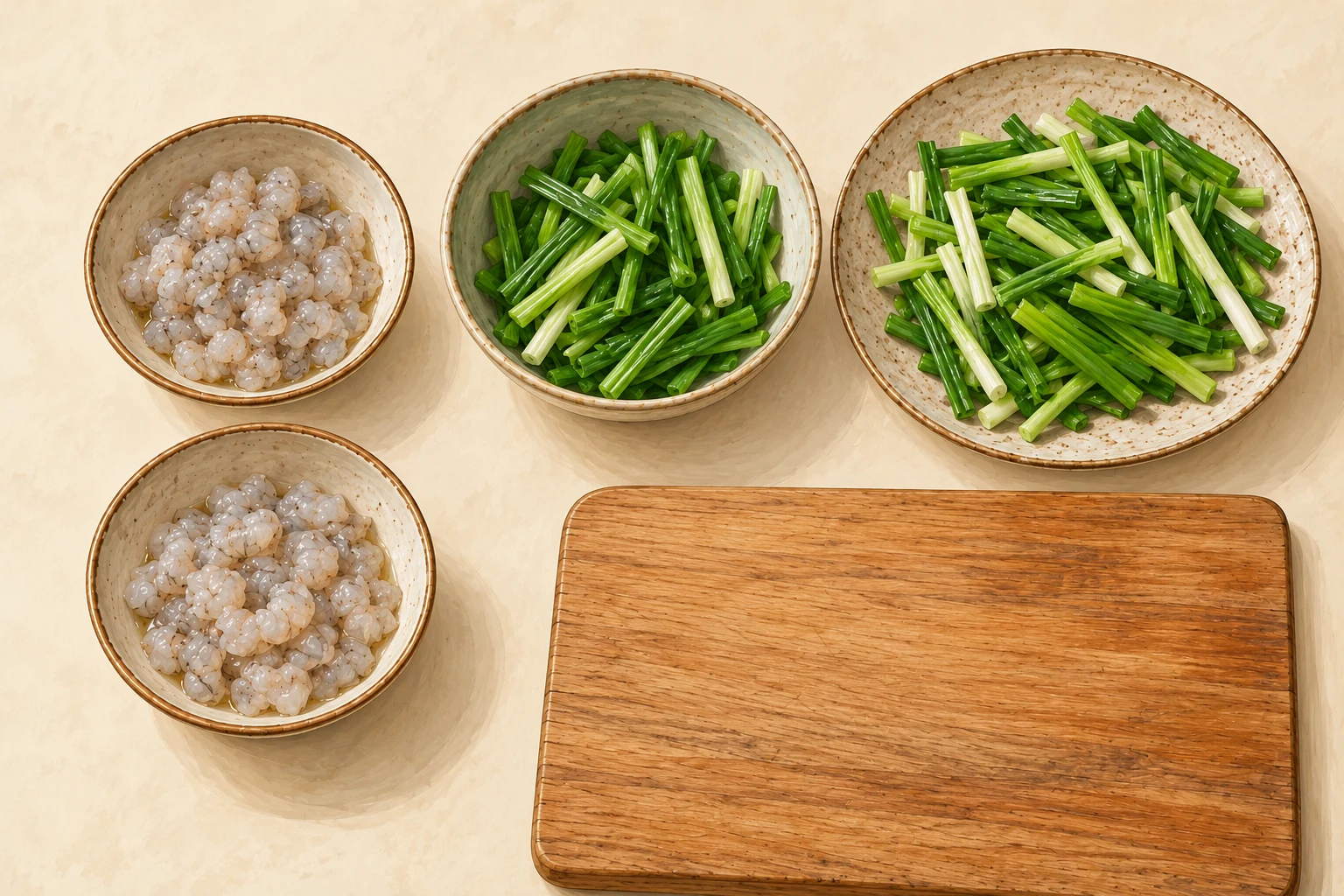
| Raw shrimp / 새우 | 180 g peeled, deveined, fully thawed and drained; chop into pieces no thicker than 1 cm | Buy raw rather than precooked; the weight excludes shells and thaw water. |
| Scallions / 쪽파 or green onions | 120 g after trimming; wash, dry thoroughly and cut into 5–7 cm strips; split thick white sections | Slender green onions can stand in for Korean small scallions. Weigh after trimming. |
| All-purpose wheat flour / 밀가루 | 120 g | Plain flour, not sweet breakfast pancake mix or a seasoned Korean premix. |
| Cold water | 180 mL, plus up to 30 mL reserved for adjustment | Add the reserve in 15 mL portions only if needed. |
| Salt / 소금 | 2 g | Weigh; a spoon conversion depends on the salt. |
| Sesame oil / 참기름 | 15 mL / 1 tablespoon | Toss with the shrimp before portioning. |
| Neutral cooking oil | 90 mL / 6 tablespoons | For two pans: 30 mL before cooking and 15 mL after turning each pancake. This is the cooking allocation, not an absorption or nutrition estimate. |
| Soy sauce / 간장 | 15 mL / 1 tablespoon | For dipping; inspect wheat and soy labeling. |
| Sauce water | 15 mL / 1 tablespoon | Keep separate from the batter water. |
Allergens: shrimp (shellfish), wheat, soy and sesame. Check every package and avoid cross-contact. A replacement ingredient does not automatically make the entire meal suitable for an allergy. This version does not add egg, squid, chili, sugar or a garnish.
1. Dry and divide the filling
Keep raw seafood and its tools apart from ready-to-eat food. Dry the prepared shrimp and scallions; toss the shrimp with the 15 mL sesame oil. Make two portions, each with 90 g shrimp and 60 g scallions. Keeping the portions separate helps prevent an overloaded first pancake and an underfilled second one.
2. Mix a batter that pours
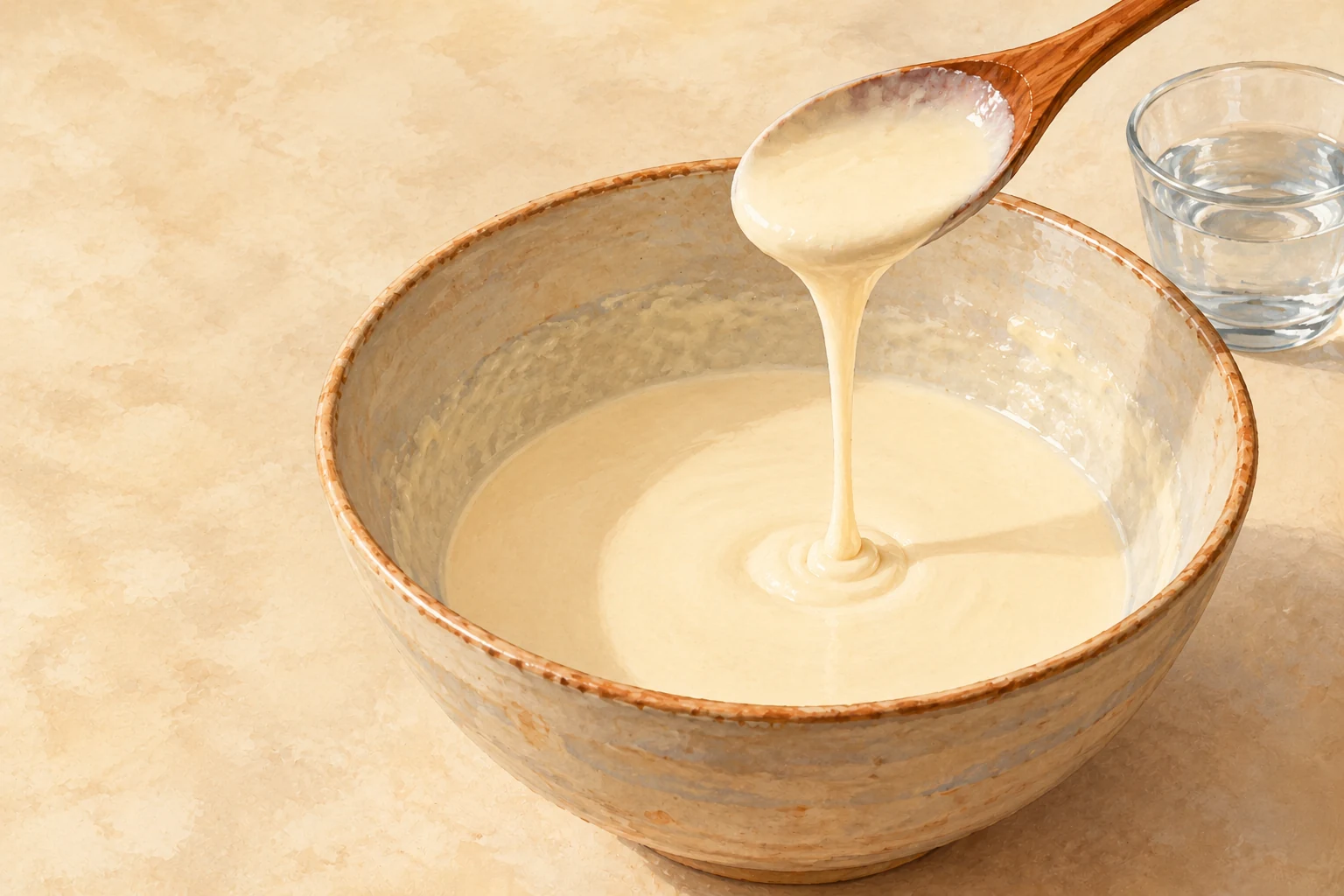
Stir the flour, salt and 180 mL cold water just until combined. The batter should pour and spread into a thin layer. If it sits in a mound, stir in 15 mL of the reserved water, then reassess; use no more than the 30 mL reserve. Stir before dividing evenly between the two pancakes. Small flour lumps do not require prolonged beating.
3. Spread the first pancake thinly
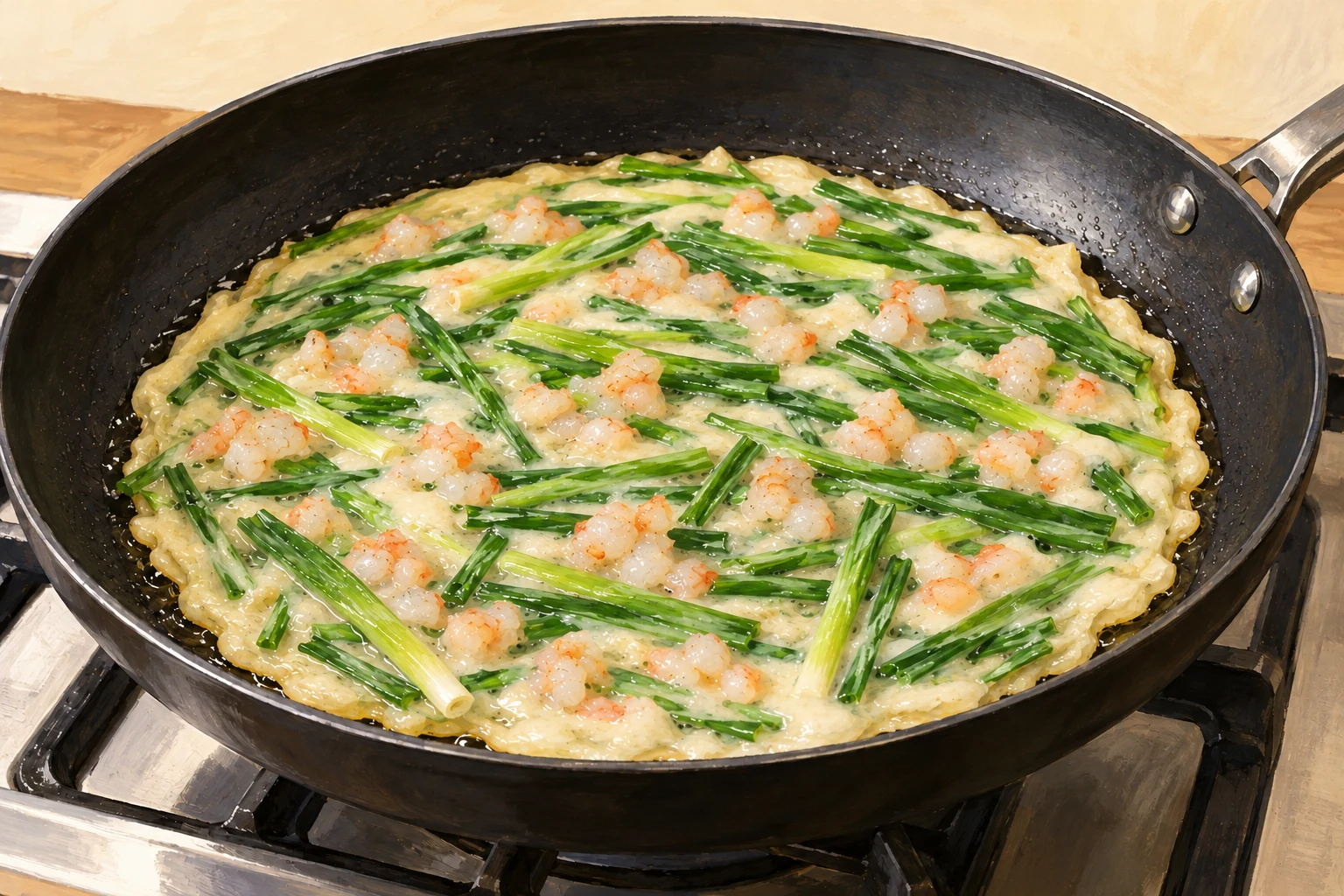
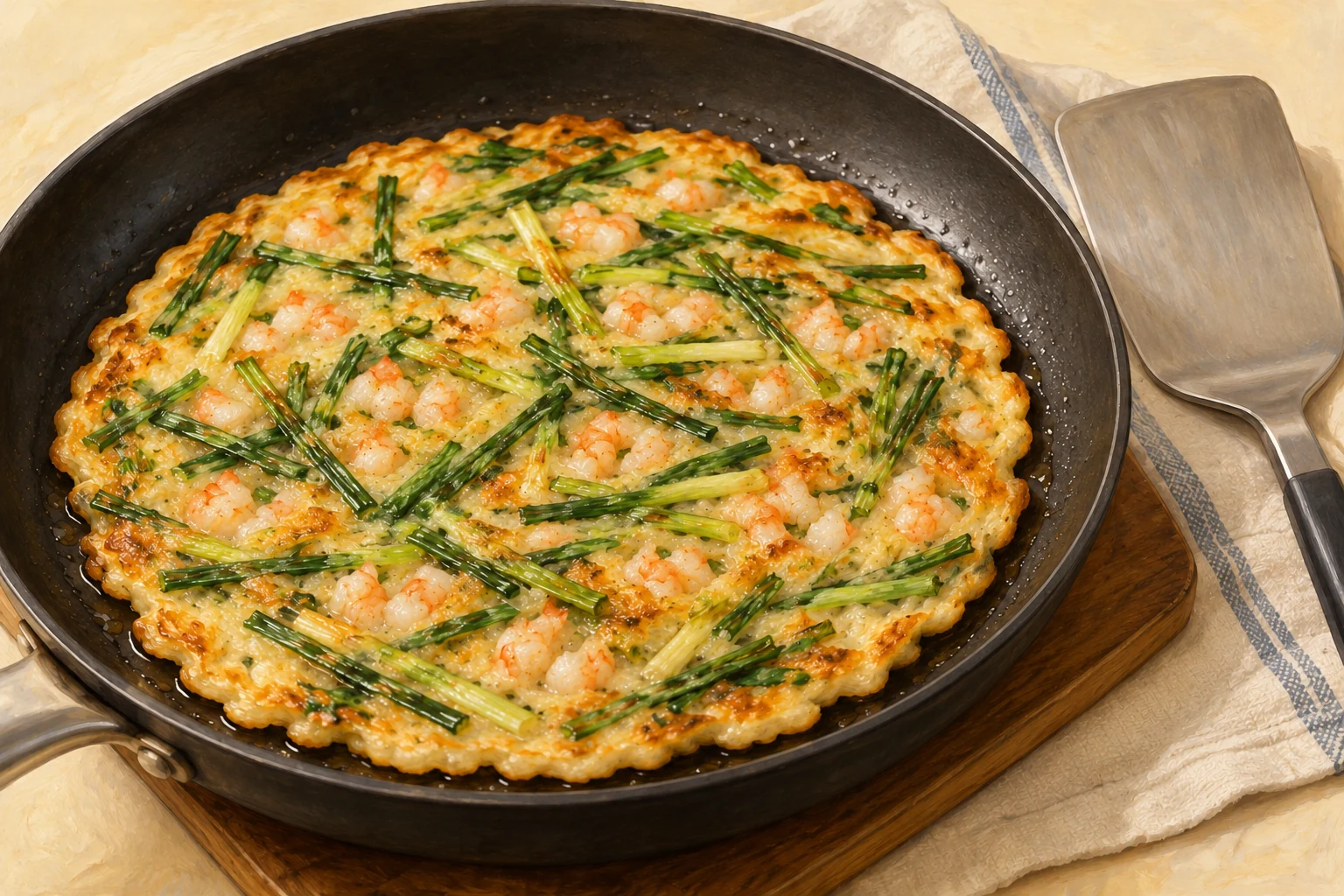
Heat 30 mL neutral oil in the skillet over medium-high heat. For the first pancake, mix 45 g of its shrimp portion into half the batter. Spread to about 20 cm across; press in its 60 g scallions and remaining 45 g shrimp in one layer. Cook approximately 3–4 minutes, until the underside is golden and the edge holds together. Lower to medium if it darkens too quickly.
4. Turn, finish and repeat
Slide a broad spatula underneath and turn carefully. Add 15 mL oil around the edge; cook roughly 3–4 minutes more. Check the shrimp reaches 145°F / 63°C with a food thermometer and is firm and opaque. The time estimate and browned surface cannot establish doneness. If the outside browns before the filling cooks, lower the heat and continue. Repeat with the second half of the batter, filling and oil allocations.
5. Serve with a simple dip
Mix 15 mL soy sauce and 15 mL clean water in a separate dish. Move the cooked pancake to a clean plate using clean utensils. Cut and serve while hot. The finished dish should have browned edges and a tender scallion filling; this describes the intended result, not a KoreanESY tasting report.
If the pancake does not behave as expected
- It tears during the flip: let the underside set before trying again, and support more of the pancake with the spatula. Finish cooking separated pieces safely rather than serving partly cooked filling for appearance’s sake.
- It browns while the middle stays wet: reduce the heat. For the next pancake, spread the same portion more evenly and keep the filling in one layer.
- It seems soggy: check whether the thawed shrimp and washed scallions were drained and dried. Extra surface water changes this small batch’s batter.
- You only have large green onions: split the thick white sections lengthwise before cutting them short. Do not substitute a pile of thick pieces and expect the same cooking time.
- You have Korean pancake mix: follow that package’s water and seasoning directions. It is a different formula; do not silently swap it for the plain flour and keep the added salt.
Shopping in the United States
Start with the seafood freezer or counter for raw peeled, deveined shrimp, the produce section for scallions, and the pantry aisles for plain flour, oils, salt and soy sauce. Readers without a Korean grocery can look for those same forms at a local supermarket. Availability and delivery coverage depend on location; no nationwide stock claim is intended.
For a Los Angeles planning example, our September 25 official-store review recorded H Mart LA Madang at 621 S Western Ave, Los Angeles, CA 90005. The October 16 store-page reader returned only the locator shell, so current hours, shelf stock and that address were not independently reverified today. Use the official store finder before traveling. This is not a claim that the pictured ingredients came from that store.
What we can and cannot price
Prices below are USD observations checked October 16, 2026. The H Mart product page displayed “Scallions 3 Bunches” at $4.99 with no postal code selected. Its region notice says offers and delivery vary. There was no usable package weight, so three bunches cannot be converted into the recipe’s 120 g or a consumed-cost figure.
| Ingredient | Retailer product / package | Full-pack price observed | Recipe-used cost |
|---|---|---|---|
| Scallions | H Mart Scallions 3 Bunches; weight unknown | $4.99, US online listing; no sale marker observed | Unknown: 120 g cannot be costed from an unweighed bunch count |
| Raw shrimp | H Mart 21–25 Count Raw Peeled & Deveined Shrimp; net pack weight unverified | Unverified; opened in a 30360 delivery context, not LA | Unknown for 180 g |
| Flour, salt, sesame oil, neutral oil, soy sauce | Choose the labeled forms above; package sizes and prices not verified | Unverified | Unverified |
Full shopping-basket cost: unavailable. Recipe-used cost: unavailable. Cost per portion: unavailable. The $4.99 observation is one product’s pack price, not a meal total or even a complete shopping subtotal. No pantry ingredients are assumed to be free. Taxes, delivery and tips are separate.
When you have your store’s labels, calculate compatible units: pack price × recipe amount ÷ pack amount. Round the number of packs upward for a first shop. Do not use shrimp “count” as a net-weight measurement or convert oil milliliters to grams without a valid conversion. Compare how much of a package you will actually use; a larger pack is not automatically the lower-waste choice.
Store and reheat safely
FDA advises refrigerating seafood promptly at 40°F / 4°C or below and using refrigerated seafood within two days of purchase or freezing it. Thaw frozen shrimp in the refrigerator, and keep raw-seafood utensils separate. Our 180 g refers to drained, peeled shrimp after thawing.
For cooked leftovers, USDA advises shallow containers and refrigeration within two hours, or one hour above 90°F. Do not wait for the pancake to cool completely on the counter. Keep the refrigerator at 40°F or below; use refrigerated leftovers within three to four days. Reheat to 165°F, checking with a thermometer in more than one place. Discard food left out beyond the safe limit. These are official general handling limits, not a tested storage-life study of this adaptation.
A few useful Korean shopping words
파 means scallion; 해물 means seafood. On this shopping list, 새우 is shrimp, 밀가루 is wheat flour, 참기름 is sesame oil and 간장 is soy sauce. Read the English ingredient and allergen panels as well as the front label. For a different rice-based meal structure, see our published bibimbap guide for two.
References
- Hyosun, Korean Bapsang: Haemul Pajeon — published December 9, 2019; updated March 8, 2021; read October 16, 2026. Cultural context and a reference method. Our gram quantities, simplified sauce and smaller oil allocation are an untested adaptation; no source photos are reused.
- FDA: Selecting and Serving Fresh and Frozen Seafood Safely — read October 13 and 15, 2026. Seafood storage, thawing and cooking guidance.
- USDA FSIS: Leftovers and Food Safety — read October 16, 2026. Cooling, refrigeration and reheating limits.
- H Mart: Scallions 3 Bunches — read October 16, 2026; $4.99 online observation, no usable weight or LA price confirmation.
- H Mart raw peeled shrimp listing — read October 16, 2026; price and pack weight unverified.
- H Mart LA Madang store page and store finder — September 25 location evidence reused; October 16 store-page access returned a shell. No current hours or availability claim.
Keep going
Ready for a guided next step?
The learning path walks you through the key ideas, one comfortable step at a time.