Bibimbap for Two: Three Vegetables, One Pan, and Sauce on the Side
By Korean ESY · Editorial standards
October 10, 2026
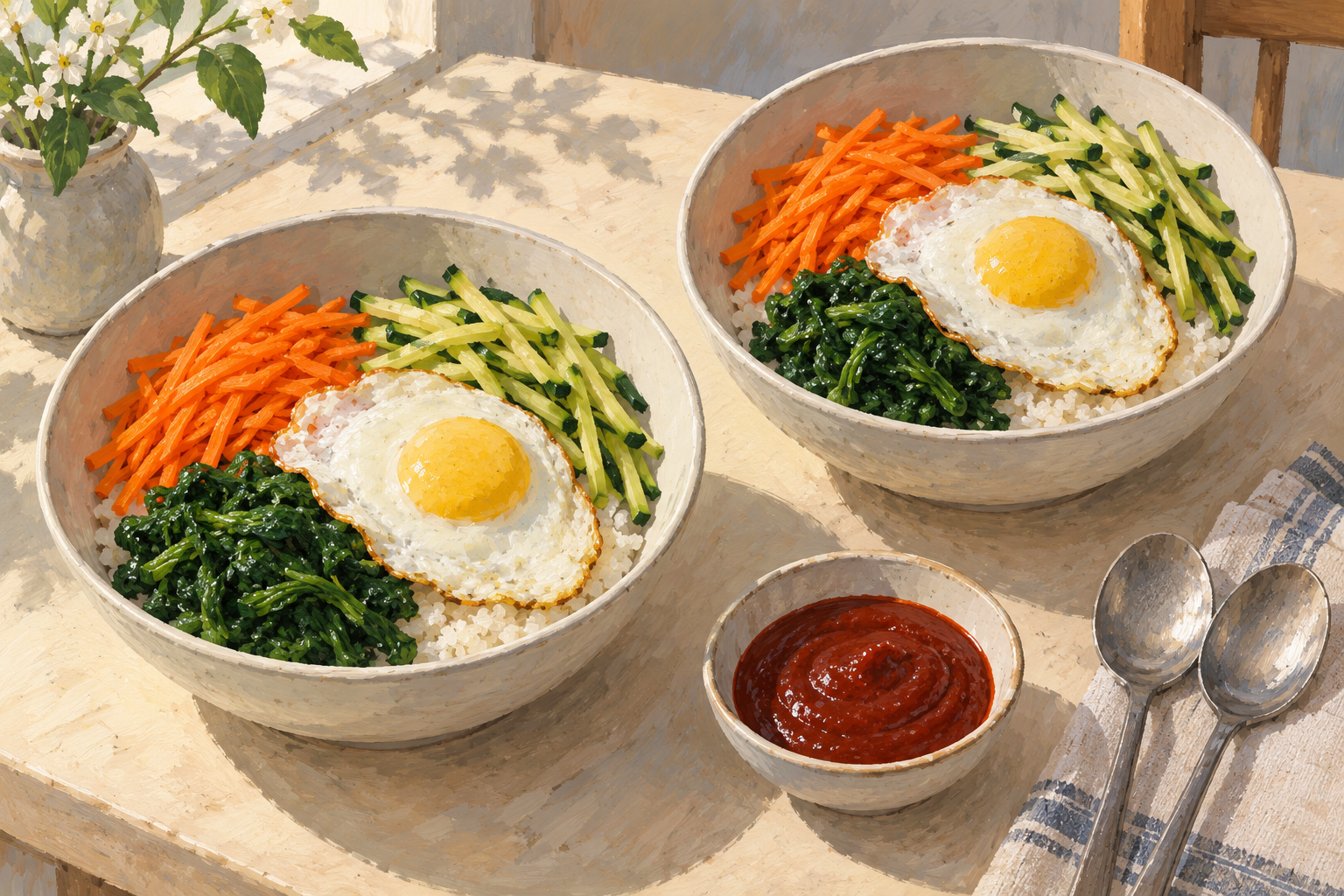
A bowl of bibimbap becomes easier to plan when you separate three jobs: cook the rice, prepare each topping, then mix at the table. This home version uses carrot, zucchini, spinach and fully cooked eggs. It makes two ordinary bowls without a hot stone pot or raw beef.
Why bibimbap this week?
Olive Young's August 24, 2026 City Log announcement used Jeonju bibimbap among its regional food references. That campaign ran August 30–September 30 and has ended. It provides a dated cultural starting point for this October 10 food guide, not evidence that bibimbap is newly trending. Our city-story packaging article explains that distinction.
This is a simplified home bowl, not a reconstruction of an elaborate Jeonju regional recipe or a brand-endorsed dish. The separate-topping and table-mixing approach is informed by Maangchi and Korean Bapsang, whose recipes are linked below. The quantities, three-vegetable selection and working sequence here are our editorial adaptation. We have not kitchen-tested this batch. Times are estimates; use the described texture and egg-doneness checks.
Recipe for two
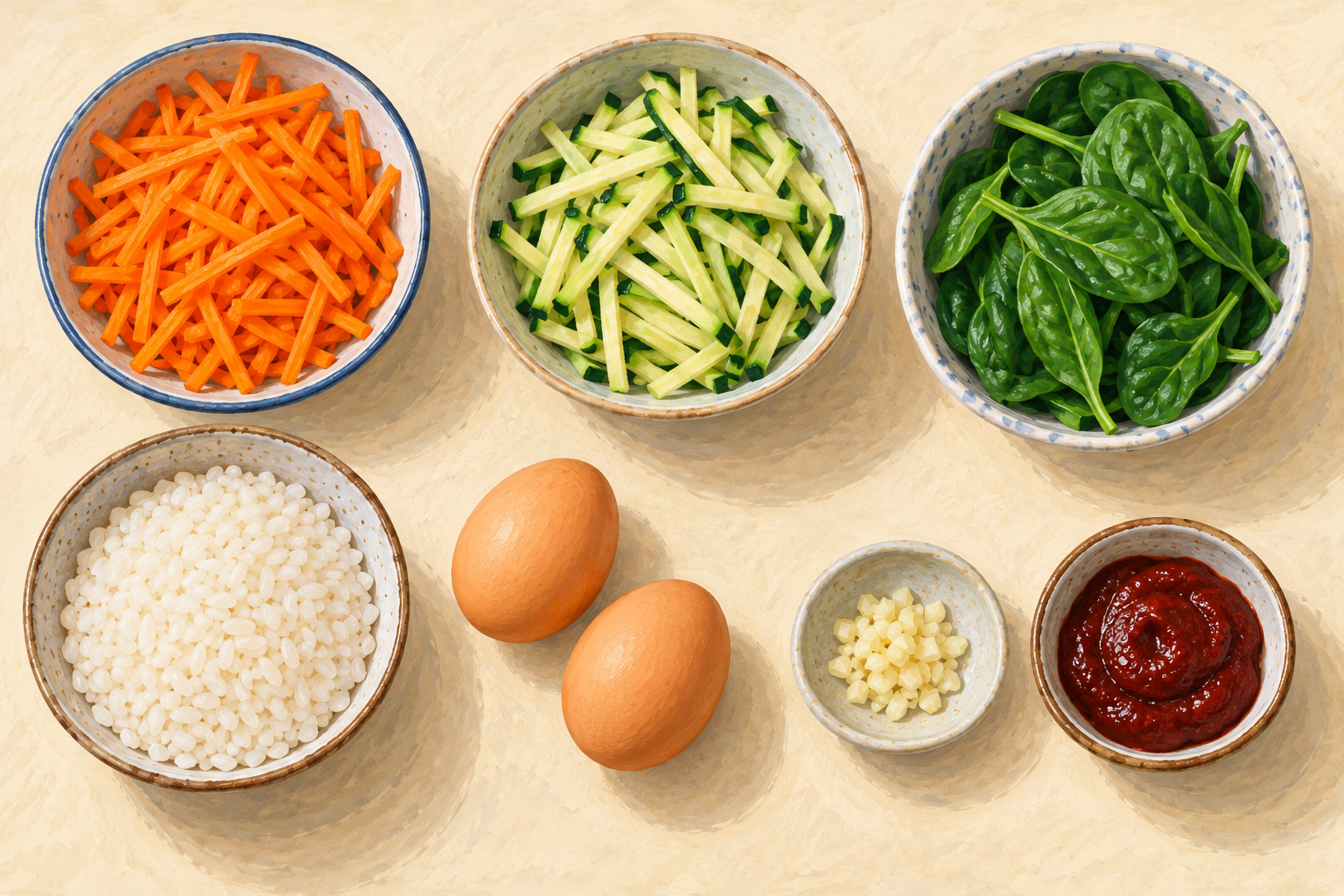
Yield: 2 bowls. Estimated time: about 45 minutes, including overlapping rice cooking and vegetable preparation. Equipment: small saucepan with lid, second pot for blanching, strainer, 10-inch nonstick skillet, spatula, cutting board, knife, scale and measuring spoons. Use ordinary serving bowls; do not put them on a burner.
Vegetable weights below are raw edible weights after trimming. Rice weight is dry. Measure salt by weight because crystal sizes differ.
| Ingredient | Amount for both bowls | Allocation |
|---|---|---|
| Dry white rice | 150 g | Cook all; divide the cooked batch equally |
| Rice water | Follow your selected rice package | Rice varieties and cookers need different ratios |
| Carrot, peeled | 100 g | Thin matchsticks, about 3 mm thick |
| Zucchini, trimmed | 150 g | Similar matchsticks; retain skin |
| Spinach, washed | 120 g | Blanch, drain and squeeze |
| Large eggs | 2 | One per bowl, both yolk and white firm |
| Neutral cooking oil | 15 mL / 3 tsp | 5 mL each for carrot, zucchini and eggs |
| Toasted sesame oil | 10 mL / 2 tsp | 5 mL spinach; 5 mL sauce |
| Garlic, finely minced | 6 g | 3 g spinach; 3 g zucchini |
| Fine salt | 2 g | 0.5 g each for spinach, carrot, zucchini and eggs |
| Gochujang paste | 30 g | Sauce; use paste rather than premixed dressing |
| Unseasoned rice vinegar | 10 mL / 2 tsp | Sauce |
| Sugar | 5 g | Sauce |
| Drinking water for sauce | 10 mL / 2 tsp | Separate from rice/blanching water |
| Water for blanching | 1 L | Discard after use |
Keep sauce separate so each diner can start with less. The listed sauce is a batch quantity, not an instruction to use all of it on each bowl. Check the gochujang label for heat level and allergens before buying.
1. Start the rice and mix the sauce
Cook 150 g dry white rice using its package water ratio and appliance instructions. For the long-grain shopping example below, the manufacturer gives a 2:1 water-to-rice ratio by volume and a covered low simmer for about 20 minutes after the water boils. Measure the dry rice's volume if using that ratio; do not apply a volume ratio to its weight. Other rice needs its own directions. Finish when the grains are tender and free water has been absorbed.
While it cooks, stir the gochujang, vinegar, sugar, 10 mL sauce water and 5 mL sesame oil together. It should be spoonable. Leave it in a separate dish.
2. Blanch and season the spinach
Bring 1 L water to a boil over high heat. Add the washed spinach and stir it under the water for approximately 30–60 seconds, until the leaves collapse and are evenly wilted. Drain, rinse briefly with cold drinking water to stop cooking, then squeeze out excess moisture with clean hands once cool enough to handle. Chop long leaves into manageable lengths. Toss with 3 g garlic, 5 mL sesame oil and 0.5 g salt. Set aside in a clean bowl.
3. Cook the carrot and zucchini separately
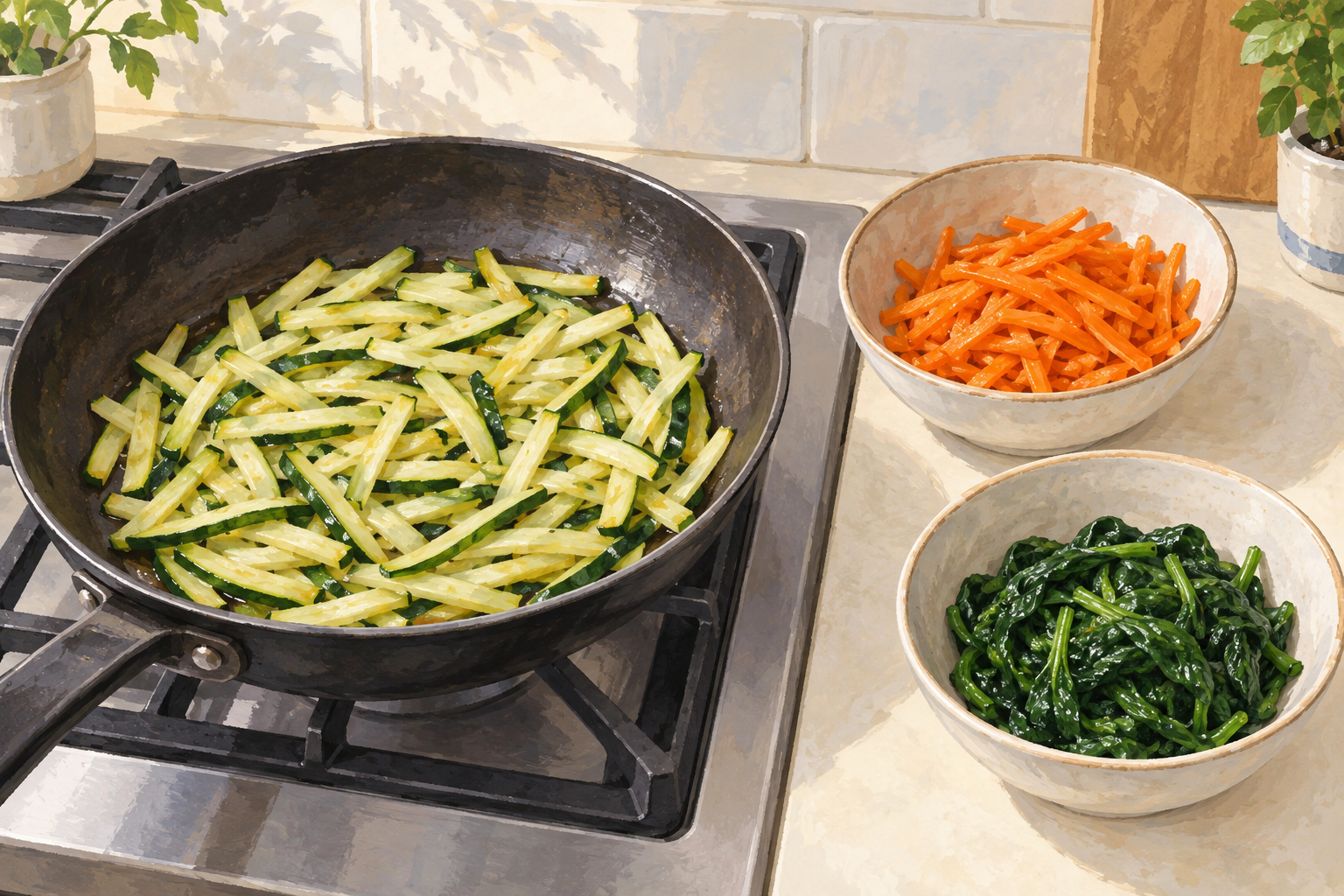
Heat 5 mL neutral oil in the skillet over medium heat. Add carrot and 0.5 g salt. Stir for approximately 3–4 minutes, until the thin strips bend and lose their hard raw center while still holding their shape. Transfer to a bowl.
Add another 5 mL oil, the zucchini and 0.5 g salt. Stir over medium heat for about 2–3 minutes, adding the remaining 3 g garlic for the final 30 seconds. The zucchini should bend easily without turning to mush. Cook a little longer if the pieces are thicker. Transfer it to a separate bowl. The benefit of separate batches is control over texture, rather than a required decorative arrangement.
4. Cook the eggs fully and assemble
Reduce the skillet to medium-low and add the final 5 mL neutral oil. Crack in both eggs. Cook for roughly 3–4 minutes until the whites have set enough to turn, flip carefully, then cook about 1–3 minutes more. Continue as needed until both whites and yolks are firm; cut into a yolk to check rather than judging only the surface. Timing varies with pan and egg temperature. Divide the remaining 0.5 g salt between the eggs.
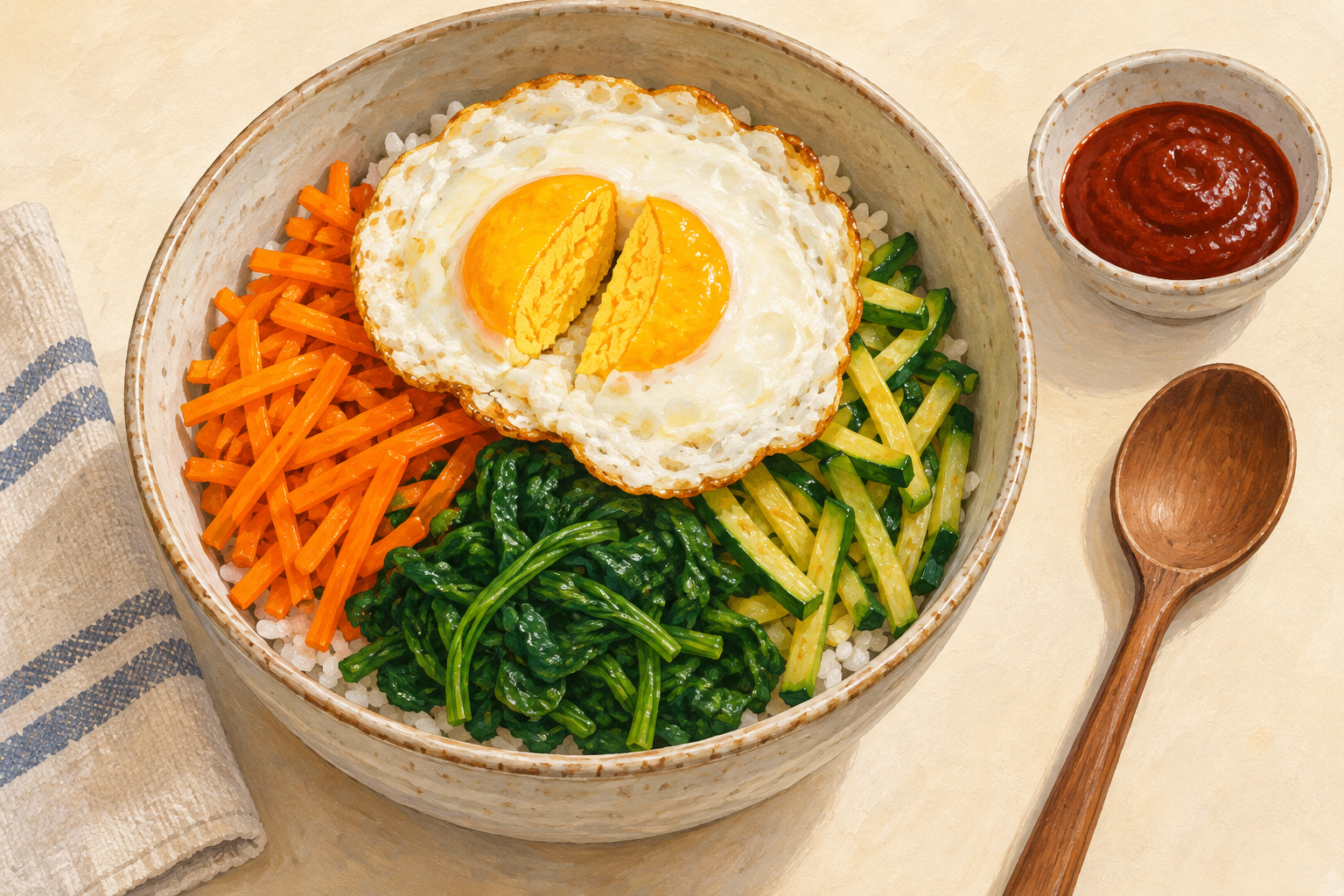
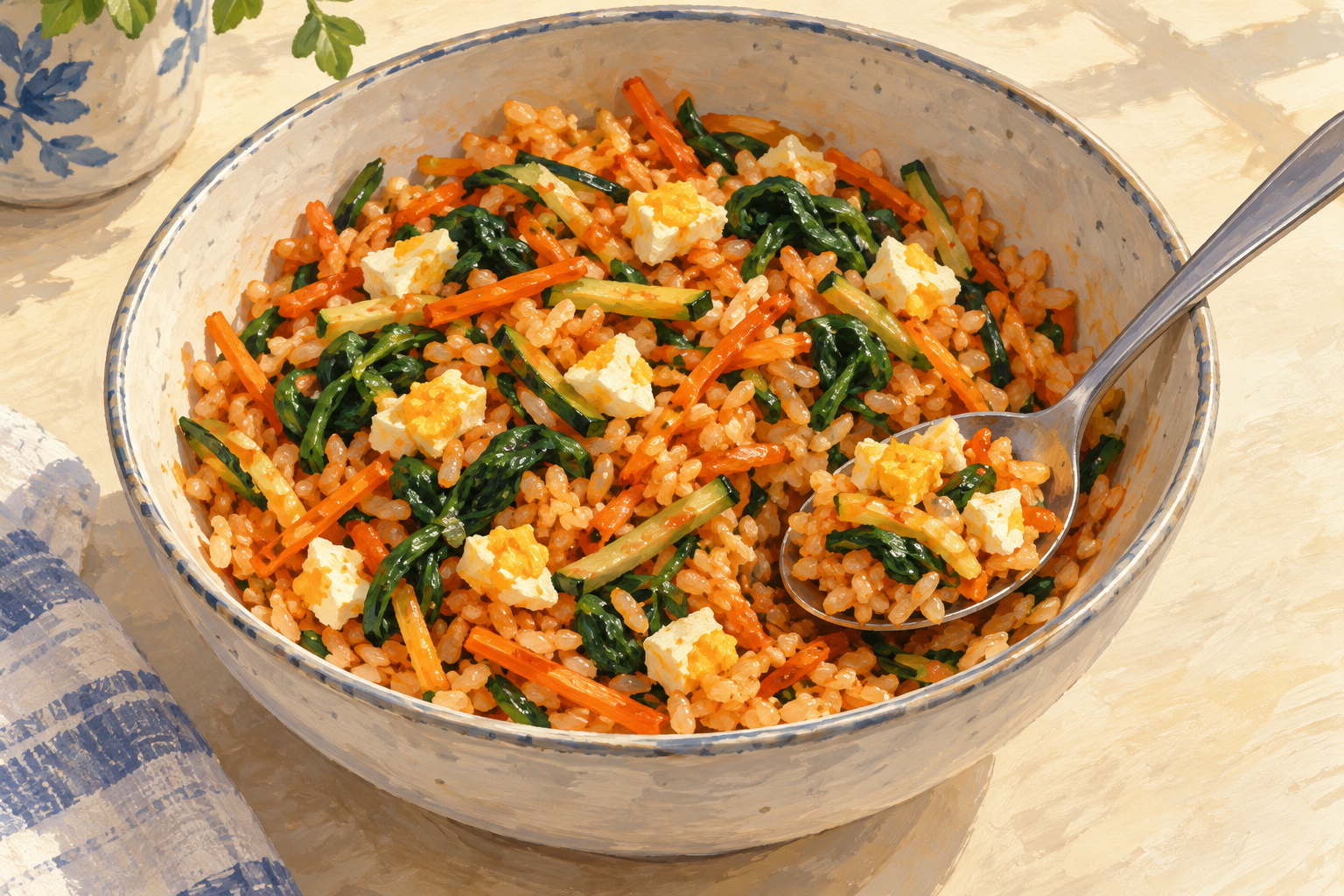
Divide the cooked rice between two bowls, then divide each vegetable topping equally. Add one cooked egg to each. Serve the sauce alongside. This follows FDA guidance on firm yolks and whites; an attractive illustration cannot demonstrate that your egg is cooked.
5. Mix, taste, then add more sauce
Start with a small spoonful of sauce in each bowl. Break the cooked egg into bite-size pieces and fold the rice and toppings together with a spoon. Taste before adding more sauce. The finished mixture should have vegetables and egg distributed through the rice, without a pool of sauce at the bottom.
US shopping and the cost we can actually verify
Prices are USD. This October 9, 2026 check found two exact official product and pack matches. The rice price was read this morning; the paste price below is the displayed official-page reference from the evening check. It is an online reference, not a verified LA shelf price, national fixed price or delivery quote.
| Item and official link | Whole pack | Displayed pack cost | Recipe amount cost | This ingredient per bowl |
|---|---|---|---|---|
| Good & Gather enriched long-grain white rice | 32 oz / 2 lb, approximately 907 g | $1.89 | About $0.31 for 150 g dry | About $0.16 |
| Haechandle mild gochujang paste at H Mart | 500 g / 1.1 lb | $5.99 | About $0.36 for 30 g | About $0.18 |
Calculation: $1.89 × 150 ÷ 907.18 ≈ $0.3125 for the batch; divide by two before rounding. The whole bag requires $1.89 at that displayed price even though this recipe uses only part of it. Long-grain rice is a practical grocery substitution with a looser texture; it is not an exact replacement for every Korean rice preference.
For the paste, $5.99 × 30 ÷ 500 = $0.3594 for the batch, or $0.1797 per bowl. The full tub still costs the displayed $5.99; this is a paste, not premixed bibimbap dressing. H Mart says offers vary by region. An earlier search listing showed a different price, so confirm your selected location and current price before shopping.
These are separate rice and paste amounts, not the cost of the meal. Prices and pack sizes for vegetables, eggs, oils and other seasonings remain unverified. We therefore provide no basket total or whole-meal price per serving. Target search results included premixed gochujang sauces; those were not treated as equivalent to the paste required here.
For a Los Angeles Korean-market example, H Mart LA Madang is at 621 S Western Ave, Los Angeles, CA 90005, based on the official store information checked September 25. Today's stock, opening hours and shelf prices were not checked. Across the US, confirm your own store's paste label, package size and price. Buy at least the edible amounts in the recipe, allowing for peel and trimming; a whole vegetable's purchase weight is not its prepared weight.
Allergens, leftovers and common fixes
Allergens: this version contains egg and sesame. Gochujang can contain soy and wheat; ingredients and cross-contact statements vary by product. Check every selected package. No gluten-free, soy-free or allergy-safe claim is made. Omitting an ingredient does not establish that the remaining food is safe for a particular allergy.
Storage: refrigerate leftovers in shallow containers within two hours, or within one hour above 90°F. Keep the refrigerator at 40°F or below. USDA guidance allows refrigerated leftovers for 3–4 days; reheat to 165°F, checking with a food thermometer. Prompt cooling matters for the rice as well as the toppings. Store sauce separately for texture. Do not leave a large rice pot on the counter to cool for hours.
- Watery bowl: squeeze the cooled spinach thoroughly and let excess zucchini moisture evaporate before assembly. Avoid pouring vegetable liquid into the rice.
- Hard carrot: cut thinner next time. For the current batch, add a teaspoon of water and cook briefly over medium-low until the strips bend; evaporate the water before transferring.
- Garlic browning too fast: reduce heat and add it near the end of the zucchini stage. Burnt garlic will not be repaired by extra sauce.
- Too much heat or salt: stop adding sauce. Mix in additional plain cooked rice if available; this changes yield and ingredient cost. More vinegar does not remove salt or chili.
- Rice still firm: follow the package's troubleshooting direction rather than adding an arbitrary large amount of water. Rice type and pot size affect the result.
A small Korean-language connection
비빔밥 names the mixed rice dish. At the table, the original practice sentence “소스를 조금 넣고 비벼요” means “Add a little sauce and mix.” The -요 ending is polite conversational language; with someone you do not know well, it is a useful default. This is our own learning example, not a quotation from a show or song.
References
- Olive Young: City Log regional character announcement. August 24, 2026 announcement; original body checked October 8. Historical food motif and ended campaign only.
- Maangchi: Bibimbap. Read October 5. Separate toppings and mixing method; this article is an independently written simplified adaptation.
- Korean Bapsang: Bibimbap. Read October 9. Dish structure, variations, optional egg and assembly; original quantities are not claimed as this recipe's tested quantities.
- Target: Good & Gather white rice, 32 oz. Product page checked October 9 for pack, displayed price and rice instructions.
- H Mart: Haechandle mild gochujang, 500 g. Official product page checked October 9; exact paste, pack and displayed $5.99 reference. Region and checkout price unverified.
- H Mart: LA Madang store. Official address checked September 25; no fresh stock or hours claim.
- FDA: What You Need to Know About Egg Safety. Checked October 9; firm white and yolk guidance.
- USDA FSIS: Leftovers and Food Safety. Read October 9; cooling, refrigeration and reheating guidance.
Keep going
Ready for a guided next step?
The learning path walks you through the key ideas, one comfortable step at a time.