Japchae for Two: A Small-Batch Noodle and Vegetable Guide
By Korean ESY · Editorial standards
October 24, 2026
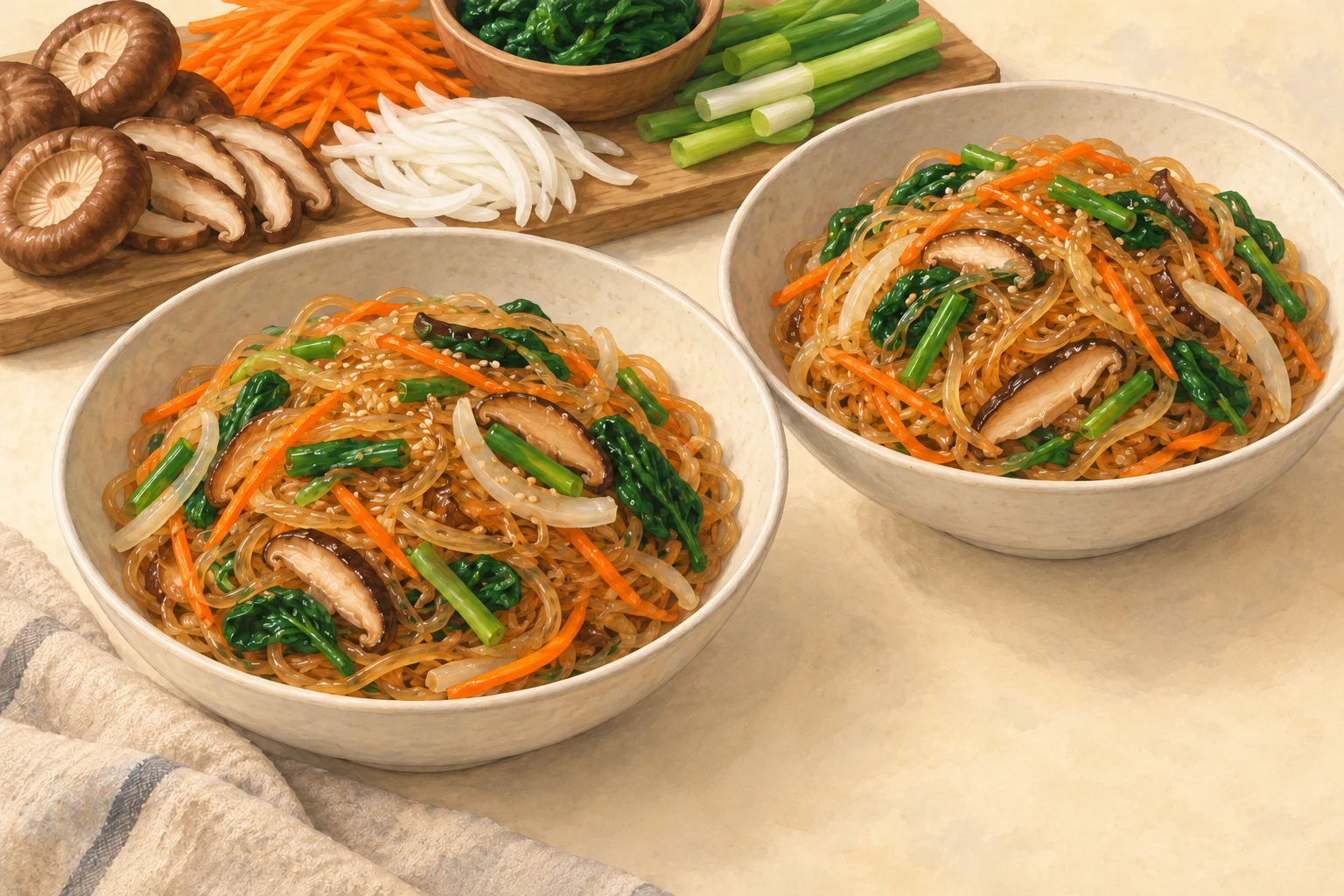
Japchae (잡채) brings springy sweet-potato starch noodles together with vegetables and a soy-sesame dressing. This meatless version makes two light portions. Its practical trick is to use one skillet in batches and a bowl to hold each finished component: wet vegetables and noodles do not all compete for pan space at once.
Editorial context, October 23, 2026: this is an evergreen cooking explainer selected for our Saturday food series, not a claim that japchae is currently viral. The method draws on Hyosun's Korean Bapsang recipe, credited below. Our smaller quantities and meatless workflow are an untested adaptation; KoreanESY has not performed a kitchen test. Illustrations explain stages, not measured portions or proven results.
Jump to recipe. If this is your first Korean grocery trip, start with the noodle package and your existing soy sauce rather than buying every seasoning in a large bottle.
Recipe card
Yield: two light portions. Estimated time: 15–20 minutes preparation plus 20–25 minutes cooking, about 35–45 minutes total; heating water overlaps preparation. Allow longer if you are learning the cuts. Skill: beginner with several separate batches. Spice: no chili in this version. Equipment: 28 cm nonstick skillet, large pot, sieve, mixing bowl, tongs, kitchen shears, scale and measuring spoons. These are estimates, not test results.
Recipe measures use 1 teaspoon = 5 mL and 1 tablespoon = 15 mL. Weights below are edible raw amounts unless specified; a tablespoon of a dry ingredient is not assumed to weigh 15 g. A scale with 0.1 g resolution is useful for the small pepper and salt quantities; those amounts are seasoning guides, not food-safety controls.
| Ingredient | Amount and preparation | Role or substitution |
|---|---|---|
| Sweet-potato starch noodles, dangmyeon (당면) | 100 g dry, about 3.5 oz | Look for noodles intended for japchae; rice or mung-bean vermicelli is a different cooking choice |
| Carrot | 45 g trimmed, thin matchsticks | Color and bite; weigh after trimming |
| Onion | 65 g peeled, thin slices | Sweetness; do not replace with the same volume of dried onion |
| Scallion | 15 g trimmed, 5 cm lengths | Green and white parts; split very thick pieces lengthwise |
| Fresh shiitake mushrooms | 60 g edible caps, stems removed, 5 mm slices | Brown mushrooms may substitute by edible weight; texture and cooking time can differ |
| Spinach | 85 g raw, washed | Blanch, cool and squeeze; do not substitute 85 g of already-cooked spinach |
| Neutral cooking oil | 10 mL total, 2 tsp | 5 mL for noodles and 5 mL for the vegetables; mushrooms use the pan's remaining film and sauce |
| Soy sauce | 25 mL, 1 tbsp plus 2 tsp | Dressing; choose your usual sauce and inspect its label |
| Sugar | 15 g | Dressing; weigh rather than infer weight from spoon size |
| Toasted sesame oil | 15 mL, 1 tbsp | Dressing, separate from neutral cooking oil |
| Garlic | 5 g, minced | Dressing |
| Toasted sesame seeds | 4 g | Dressing; no additional garnish required |
| Ground black pepper | 0.2 g | Dressing |
| Salt | Up to 0.5 g total | Half for spinach, half for vegetables; omit if your sauce is already salty enough |
| Water | 2 L for the pot; an additional 15 mL only if needed | Boiling water is drained; the extra tablespoon is a clump-rescue option |
1. Cut everything and divide the dressing
Wash the produce and make the cuts in the table. Keep raw spinach separate. Mix soy sauce, sugar, sesame oil, garlic, sesame seeds and pepper until the sugar dissolves. Weigh the mixed dressing: reserve half for noodles, one quarter for mushrooms and one quarter for the final toss. Stir before dividing so the solids do not all stay at the bottom. Do not estimate the finished sauce volume by adding the ingredient volumes.
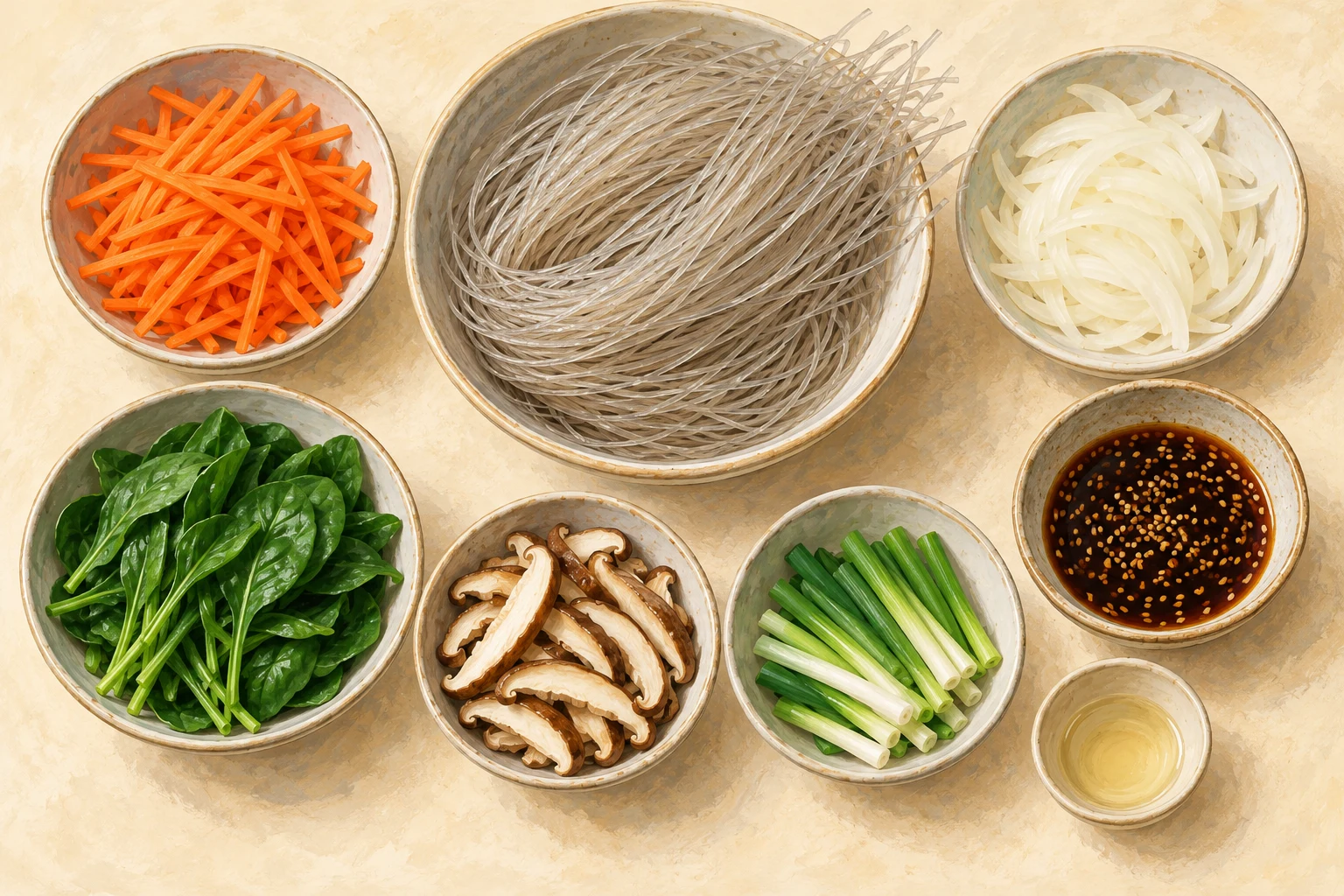
Set a large empty mixing bowl beside the skillet before you start. Three small dishes for the dressing portions make it easier to avoid using the finishing portion too early. This simple setup is especially helpful when one person is both boiling noodles and watching a pan.
2. Blanch spinach, then cook and drain the noodles
Bring 2 L water to a boil. Blanch spinach until the leaves collapse, checking from about 20 seconds; lift it into a sieve, cool under running water, squeeze and chop coarsely. Season with up to 0.25 g salt. Return the pot to a boil and cook the noodles according to their package; the reference recipe's 6–8 minutes is a comparison, not a universal brand instruction. Check for a flexible, translucent strand without a firm center. Drain, rinse cool, drain thoroughly and cut to manageable 15–18 cm lengths. Toss with half the dressing.
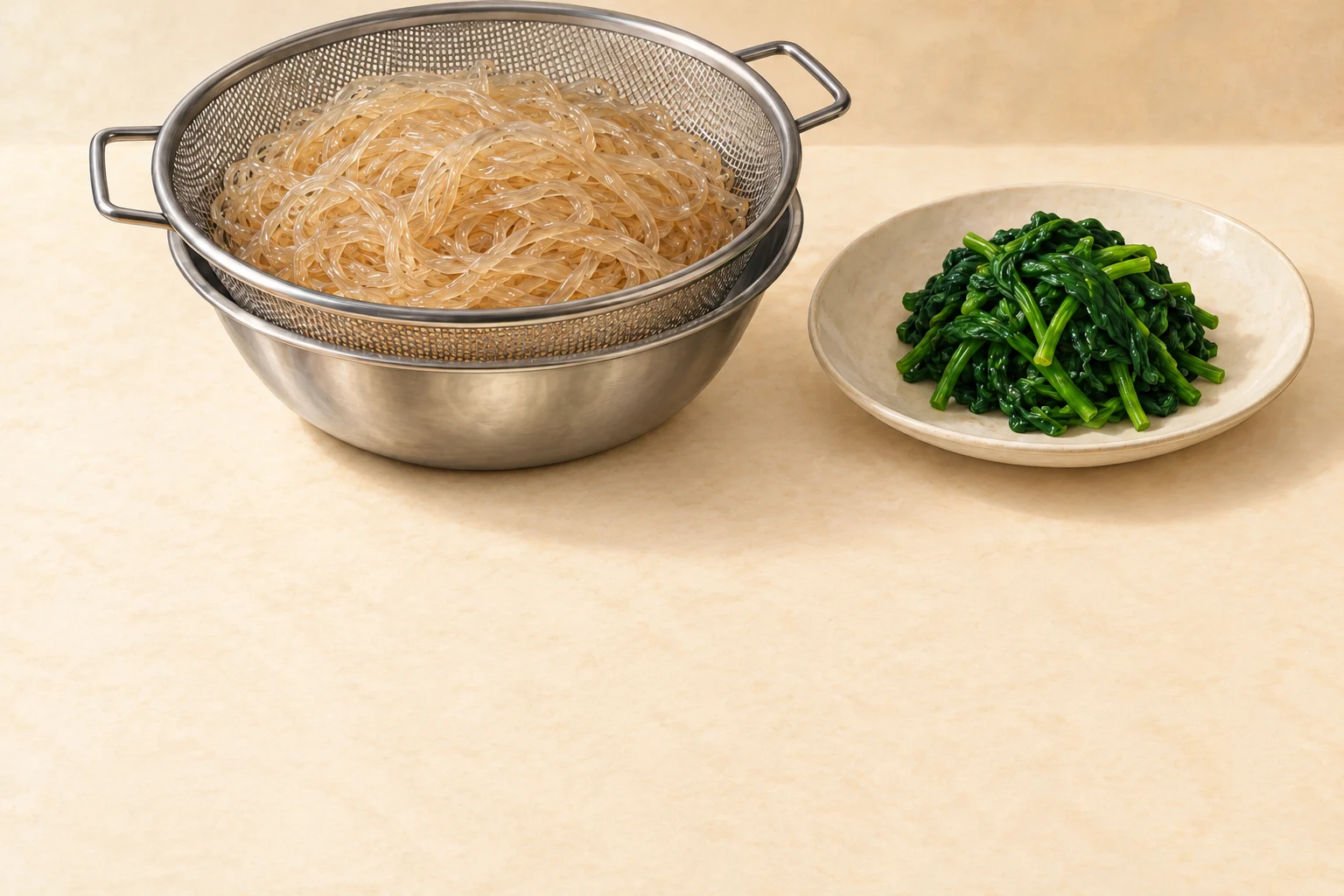
Blanching the spinach first lets you reuse the same pot of water. Use tongs to lift it out carefully and keep the hot pot stable. Neither illustration nor cooking time replaces checking the noodle texture. The sieve should sit above the collected water, not soak in it.
3. Cook separate batches in one skillet
Heat 5 mL neutral oil over medium to medium-high heat. Toss dressed noodles for roughly 3–4 minutes until glossy, without pooled water; transfer to the bowl. Add the remaining 5 mL oil, cook carrot about 1 minute, then onion 1–2 minutes and scallion briefly until flexible but lightly crisp. Add up to 0.25 g salt and transfer out. Over medium heat, cook shiitake with its quarter of dressing for about 2–3 minutes, until softened. Lower heat if the dressing catches; these are estimated adaptation timings.
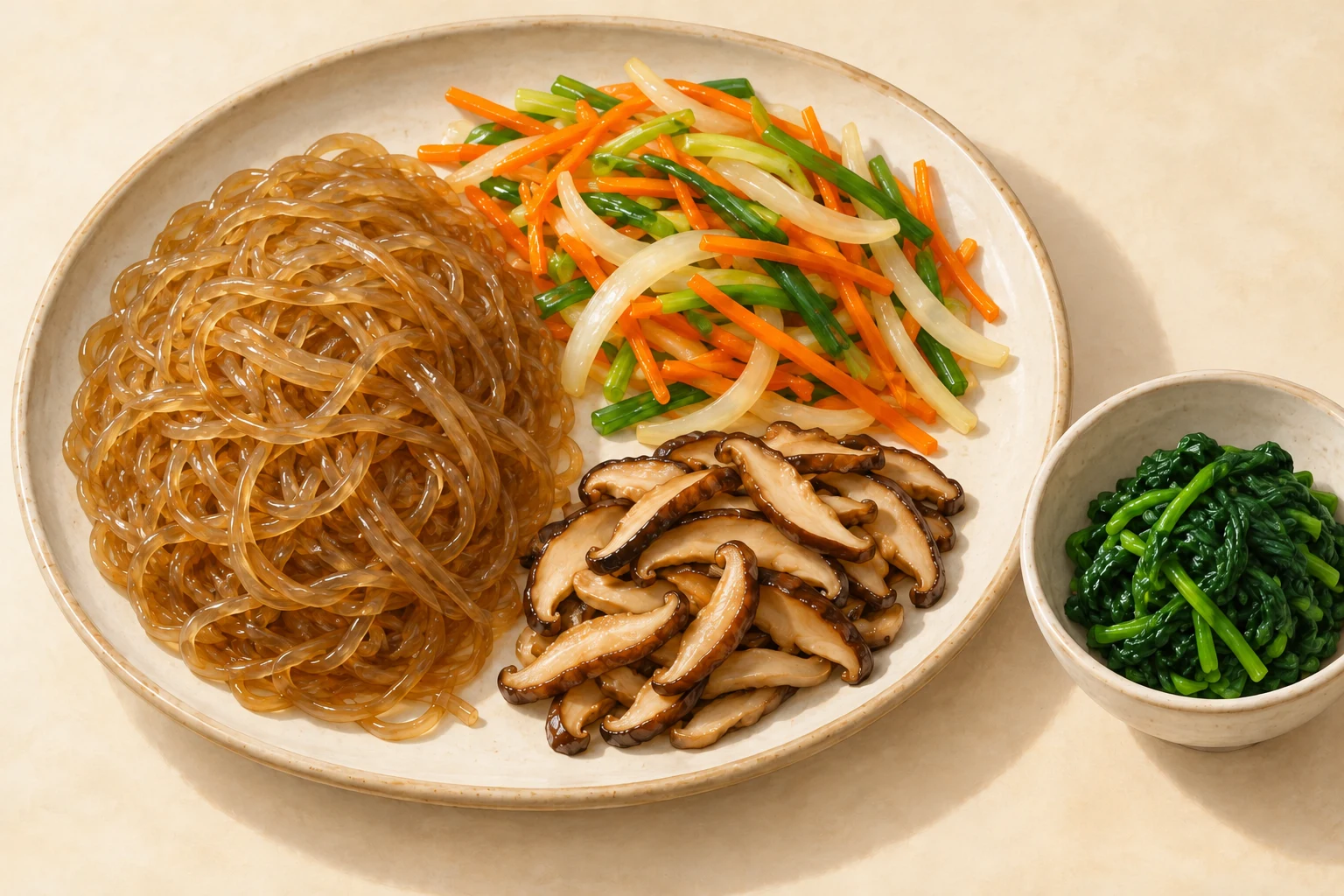
Keep the noodle bowl off the burner. A holding bowl is not another cooking pan, and the ingredients can go into that bowl as they finish. Separate piles in the illustration make the sequence easier to see; you do not need an extra serving platter. If the pan becomes dry before the mushrooms soften, lower the heat rather than letting the sugar scorch.
4. Toss, check and portion
Combine the cooked batches, squeezed spinach and final quarter of dressing with tongs until evenly coated. Divide into two light portions. If the noodles clump, loosen them briefly in the warm skillet with the optional 15 mL water. If liquid pools, stir briefly over medium heat before serving. The aim is separated, glossy strands, not a puddle of sauce.
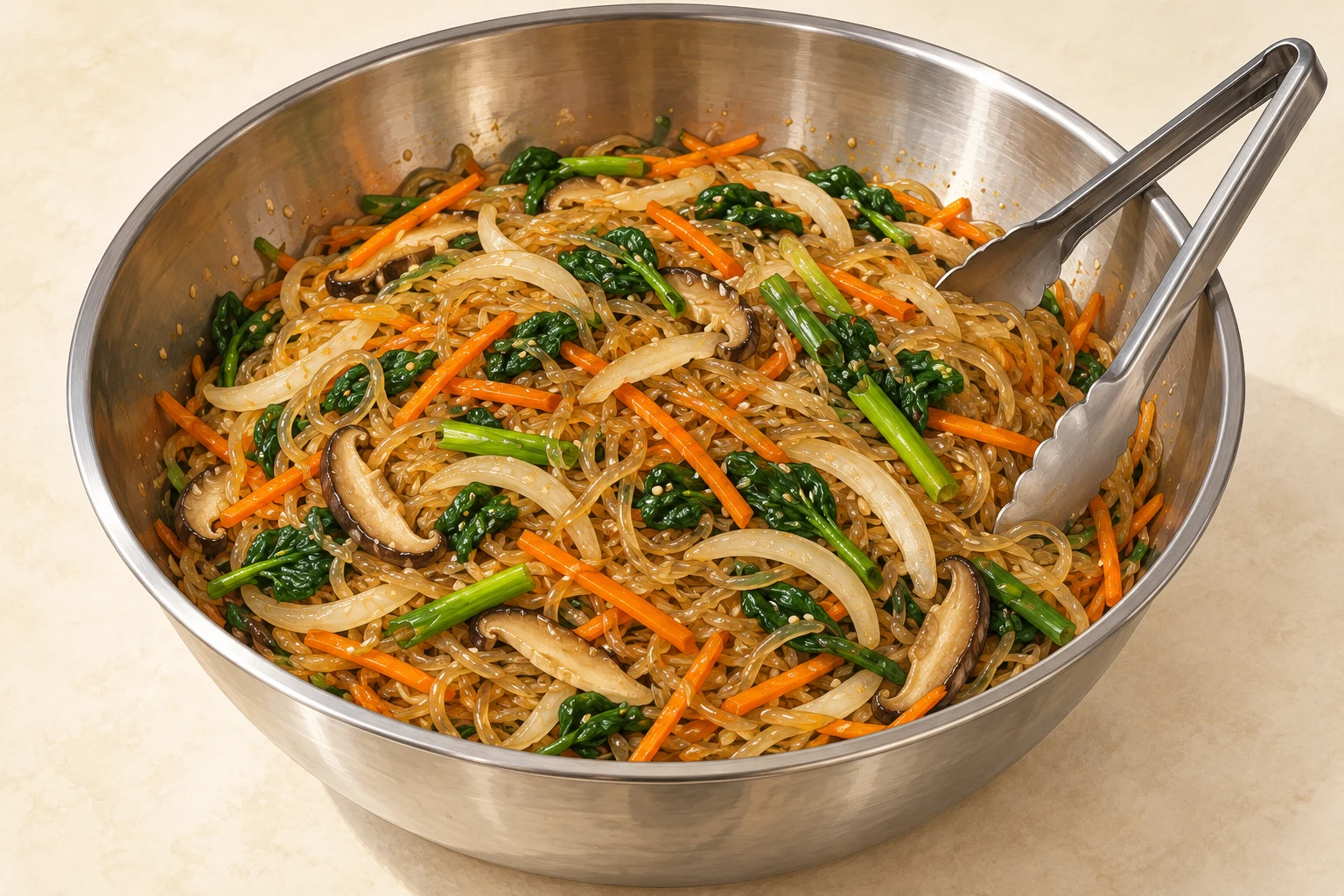
Taste after everything is combined before deciding whether the optional salt is needed. This version uses only the listed dressing, with no additional dipping sauce or garnish. For a precise first attempt, follow the listed amounts and note what you would change next time.
Fixes and label checks
- Hard center: the noodles need more cooking before dressing. Return them to boiling water and check again; extra sauce cannot cook a firm center.
- Clumped strands: first separate gently with tongs and the measured rescue water. Pouring in more oil changes the recipe without necessarily loosening the center of a clump.
- Watery bowl: squeeze spinach and drain noodles more thoroughly next time. For the current batch, briefly return the mixture to medium heat and stir; avoid adding more dressing while water is visible.
- Burnt dressing: lower heat and remove badly scorched pieces. More sugar or sesame oil does not remove a burnt flavor.
- Allergens: this version contains soy and sesame; ordinary soy sauce can also contain wheat. Inspect the actual noodle and sauce labels, including cross-contact warnings. A plant-based ingredient is not automatically allergy-safe. The retailer text checked for the noodle example did not provide a complete ingredient/allergen label, so this guide does not certify that product for a restricted diet.
Fresh brown mushrooms can replace shiitake by edible weight. A different leafy green needs its own texture check and is not a tested equivalent. For the first attempt, keep the noodle type and dressing quantities stable so you are not changing several variables at once. No nutrition or health benefit is claimed.
US shopping: choose the noodle before buying the rest
Search for dangmyeon / 당면 / sweet potato vermicelli in a Korean market's noodle aisle or online. Check the actual package for starch type, cooking instructions, ingredients and allergens; the product name alone is insufficient. Soy sauce is ganjang / 간장 and toasted sesame oil is chamgireum / 참기름. These words help with searching, not with certifying a particular bottle.
Our named example is H Mart's Dongwon Sweet Potato Vermicelli, 14.1 oz (400 g), SKU 351, observed at $8.99 USD on October 23, 2026 through its US online listing with no ZIP selected. This is not an LA shelf price or national average. Stock, sale status, delivery to your address and the complete ingredient label were not established. Confirm them before purchasing. Produce and pantry ingredients can come from an ordinary local supermarket; compare edible quantity and what you will actually use, not only pack price.
For an LA example, H Mart's official locator lists LA City Center, 3500 W 6th St, Los Angeles, CA 90020, checked October 23. This is a store-location example, not a stock or price promise. Readers elsewhere in the US should use the locator or check a retailer serving their ZIP. We have not verified nationwide delivery coverage.
| Cost measure | Verified amount | What it does and does not include |
|---|---|---|
| One full noodle pack | $8.99 for 400 g | Only the named online noodle listing; one pack covers the 100 g dry requirement |
| Noodles consumed in this recipe | $8.99 × 100 / 400 = $2.2475, displayed $2.25 | Noodles only; 300 g dry remains in the purchased pack |
| Noodle component per light portion | $2.2475 / 2 = $1.12375, displayed $1.12 | Noodles only, not the cost of a complete portion; calculate before rounding |
| Complete grocery basket | Unknown | Carrot, onion, scallion, mushrooms, spinach, both oils, soy sauce, sugar, garlic, seeds, pepper and salt are not priced here |
| Complete recipe-used cost and cost per portion | Unknown | No invented pantry value or unverified subtotal is treated as a meal total; taxes and delivery are also excluded |
If you already own some seasonings, mark those on your shopping list but do not pretend their consumed cost is zero. Keep the full-pack receipt separate from the recipe worksheet. For a second batch, use the same observed pack price only if it still reflects what you paid. A larger pack is useful only if you expect to use it; no saving is established without a second verified unit price.
Leftovers and a useful Korean follow-up
Following USDA leftover guidance, refrigerate promptly in shallow containers within 2 hours, or within 1 hour when the temperature is above 90°F. Keep the refrigerator at 40°F or below, use refrigerated leftovers within 3–4 days and reheat to 165°F. Do not leave the bowl on the counter waiting for it to cool completely. These are general safety limits, not a measured shelf-life test of this adaptation.
For a different measured food project, see our shrimp and scallion pancake guide. When reading ingredient names, separate a familiar Korean word from what a particular package actually guarantees. Our Korean brand and manufacturing-claim guide teaches that distinction in another shopping context.
References
- Hyosun, Korean Bapsang: Japchae — author's recipe and cooking-method reference, read October 19 and 23, 2026. Our smaller meatless quantities and workflow are an untested adaptation; prose and illustrations are original.
- H Mart: Dongwon Sweet Potato Vermicelli 14.1 oz (400 g) — named product, pack and online USD price, rechecked October 23, 2026; complete ingredient/allergen label not available in the text read.
- H Mart store locator — LA location example, checked October 23, 2026; no current shelf-price or stock verification.
- USDA FSIS: Leftovers and Food Safety — general storage and reheating limits, read October 21, 2026 and reused with that check date.
Keep going
Ready for a guided next step?
The learning path walks you through the key ideas, one comfortable step at a time.