Tteokkochi for Two: A Small-Batch Rice Cake Skewer Guide
By Korean ESY · Editorial standards
September 26, 2026
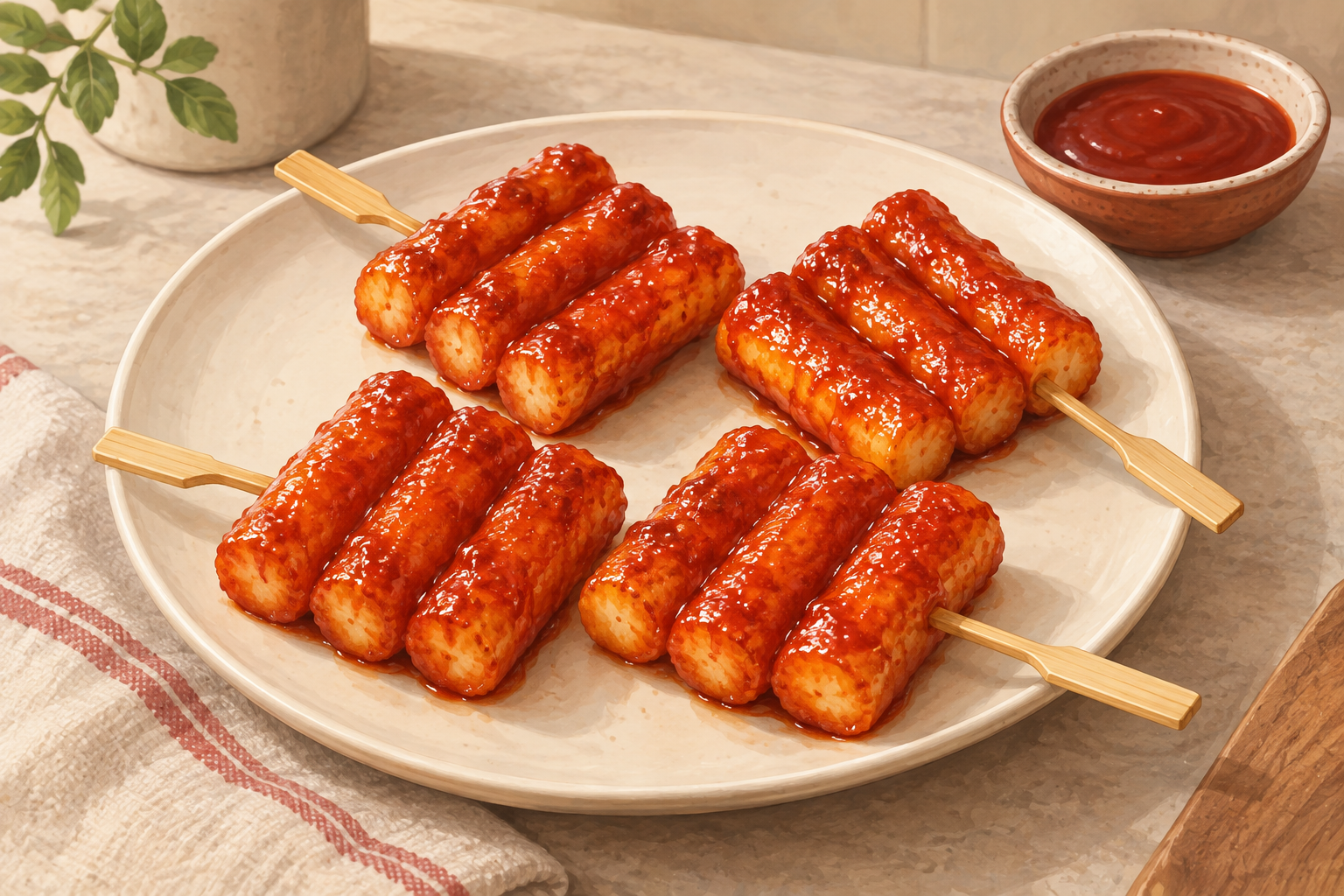
A rice-cake skewer is a different cooking project from a pot of tteokbokki: the sauce goes on the outside after the rice cakes meet the pan. This guide gives you a weighed two-person snack, four illustrated checkpoints, and a shopping calculation that separates the rice-cake cost from the cost of the whole recipe.
A food connection from KPop Demon Hunters
Netflix's December 5, 2025 food guide identifies tteokkochi in the film's end credits. That dated detail is the reason for this food explainer; it does not establish that the dish is trending this week. We have no verified current social trend evidence for it.
떡꼬치 is written tteokkochi or tteok kkochi. At a grocery store, search for 떡볶이떡 / tteokbokki rice cakes: the short cylinders are the form needed here. Thin oval soup-rice-cake slices will not make the same skewers.
What you are making
Yield: two snack servings, divided by weight rather than a guaranteed number of skewers. Time: allow about 25 minutes with soft rice cakes; hard or frozen cakes can need extra preparation. This is a planning estimate, not a timed kitchen test. Difficulty: beginner, with attention needed when drying and pan cooking. Spice: gochujang makes the glaze spicy; the level depends on the product.
The ingredient proportions and medium-heat pan method are adapted from Holly Ford's Beyond Kimchee recipe, scaled to half of its four-person batch. Half a pound rounds to 227 g; that is not a conversion from a piece count. We choose strawberry jam and the upper end of the source's water range, and omit its optional pepper and nut topping. KoreanESY has not kitchen-tested this adaptation. Package-specific preparation instructions take priority.
Use a scale, measuring spoons, a saucepan, a wide nonstick skillet, a colander, paper towels, tongs and short food-safe skewers that fit entirely inside the skillet. Never force a sharp skewer through a hard cake toward your hand. The illustrations show selected portions, not a weighing guide.
| Ingredient | Quantity for two | Buying form / where it goes |
|---|---|---|
| Rice cakes / 떡볶이떡 | 227 g (8 oz), weighed before blanching | Plain short cylinders; steps 1, 3 |
| Canola oil | 1 tbsp (15 mL) | Pan; step 3 |
| Gochujang / 고추장 | 1½ tbsp (22.5 mL) | Fermented chili paste; step 2 |
| Ketchup | 1 tbsp (15 mL) | Sauce; step 2 |
| Minced garlic | ¾ tsp (3.75 mL) | Fresh, finely minced; step 2 |
| Strawberry jam | ½ tbsp (7.5 mL) | Sauce; step 2 |
| Honey | ½ tbsp (7.5 mL) | Sauce; step 2 |
| Water | 1 tbsp (15 mL), plus water for blanching | Sauce; step 2 |
Spoon measures here use a kitchen convention of 1 tablespoon = 15 mL and 1 teaspoon = 5 mL. Volumes are not ingredient weights. A scale resolves the main shopping ambiguity: a thicker cylinder weighs more even if the piece count stays the same.
Four cooking checkpoints
1. Soften, then dry
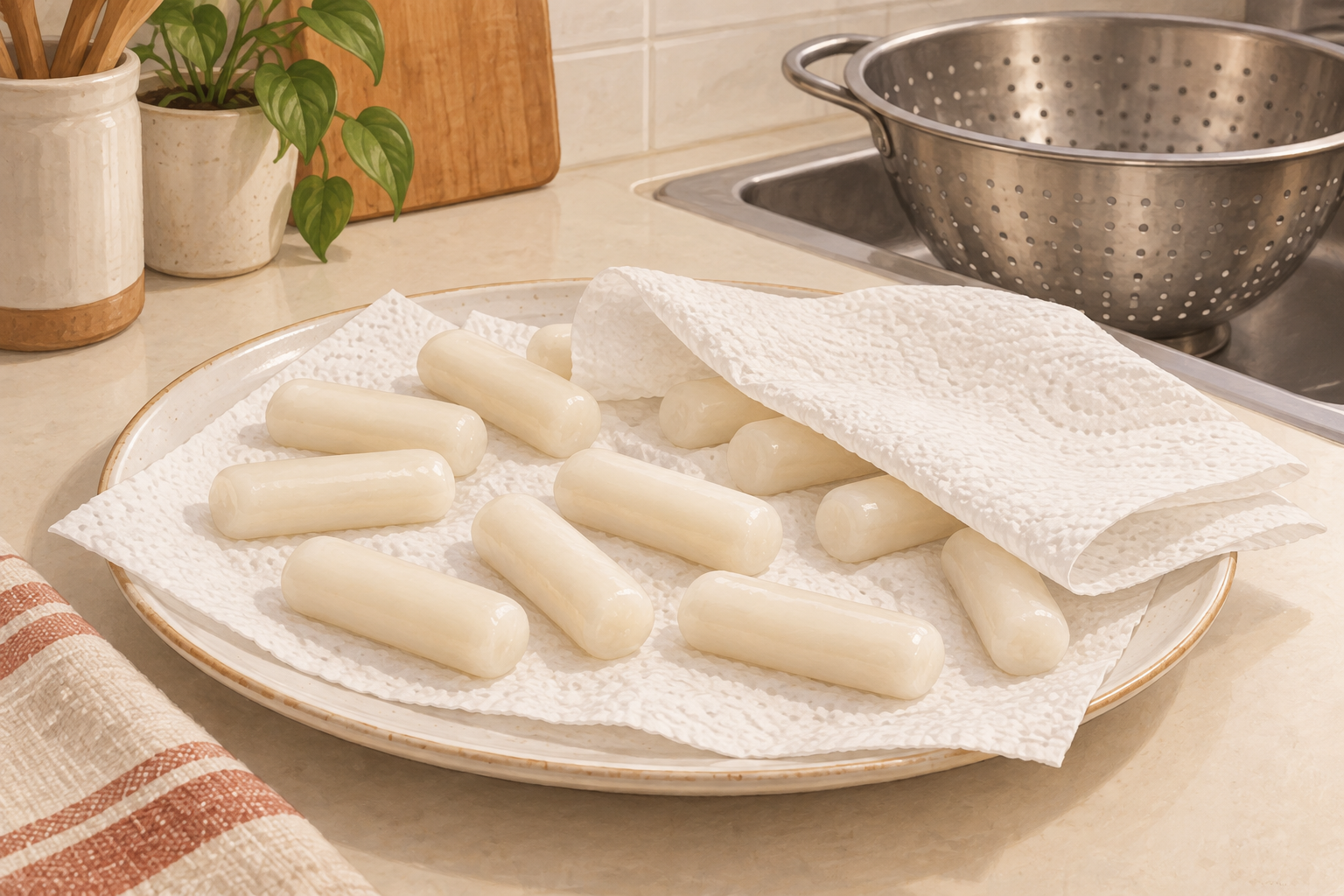
For hard chilled cakes, blanch in boiling water until pliable; start checking around 30 seconds and continue as needed. Follow the pack's instructions for frozen cakes. Drain, briefly rinse cool, then thoroughly blot dry. Soft fresh cakes can skip blanching. The cake should accept a skewer without splitting; its surface must not carry water into the oil.
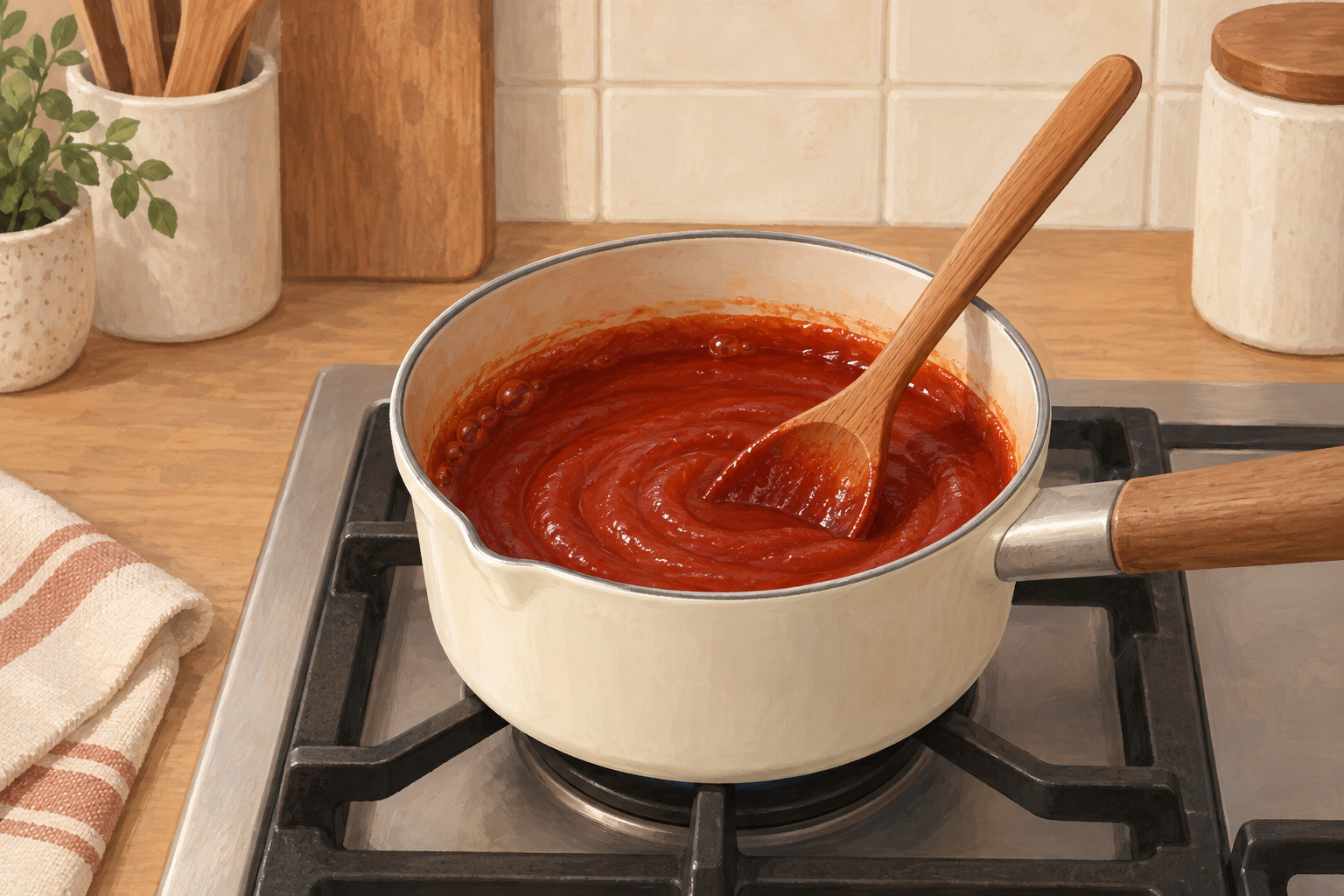
2. Warm the glaze
Combine gochujang, ketchup, garlic, jam, honey and the 15 mL water. Over medium heat, stir to a gentle bubble and cook about one minute, until slightly thicker. Set aside; lower the heat if it spits or catches.
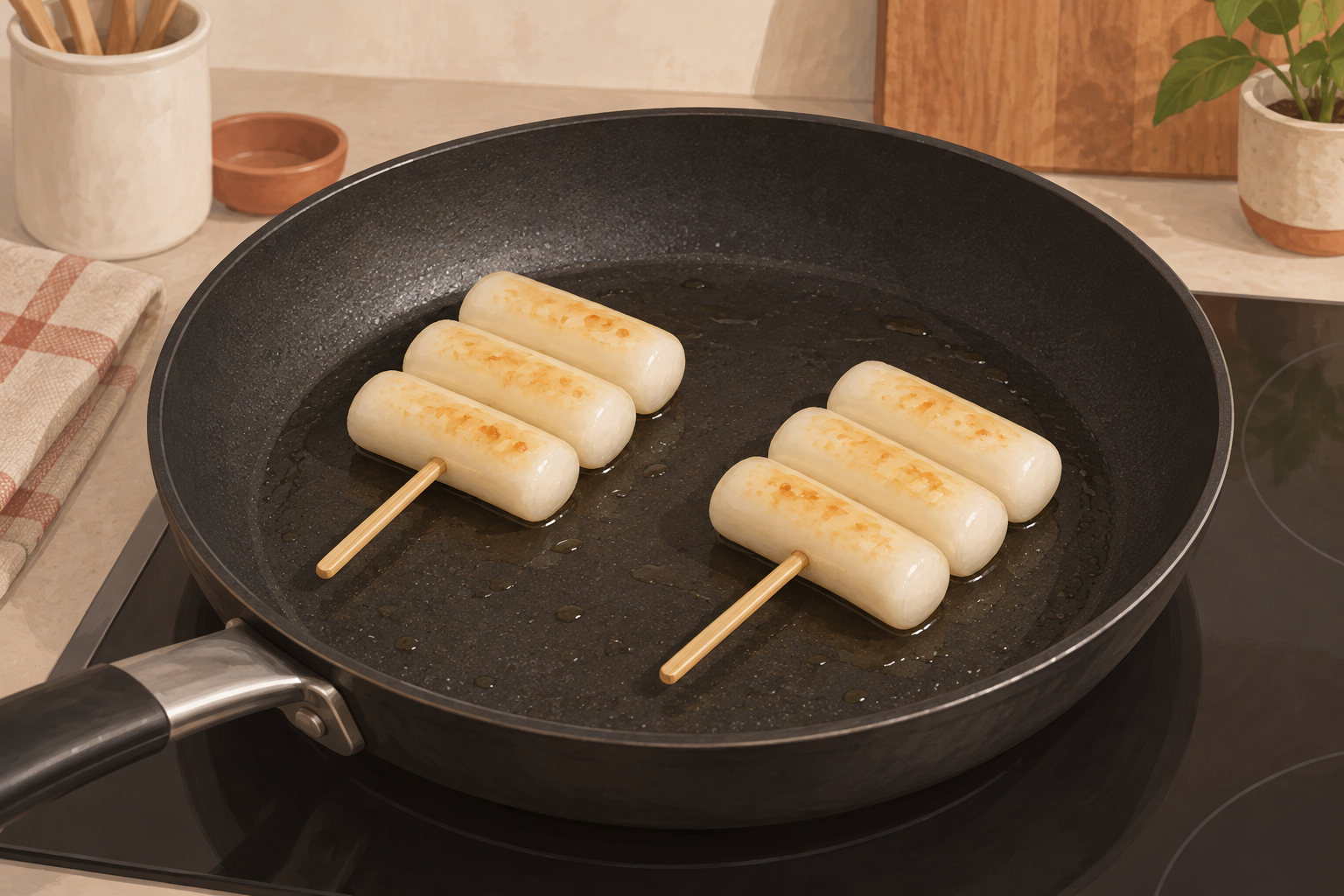
3. Cook the plain skewers
Thread three or four softened cakes crosswise per skewer, leaving a handle. Heat the 15 mL oil over medium heat. Cook without crowding, about 2–3 minutes per side, until the surface develops crisp, lightly golden patches. Lower the heat if browning races ahead; work in batches if necessary.
4. Brush away from the heat
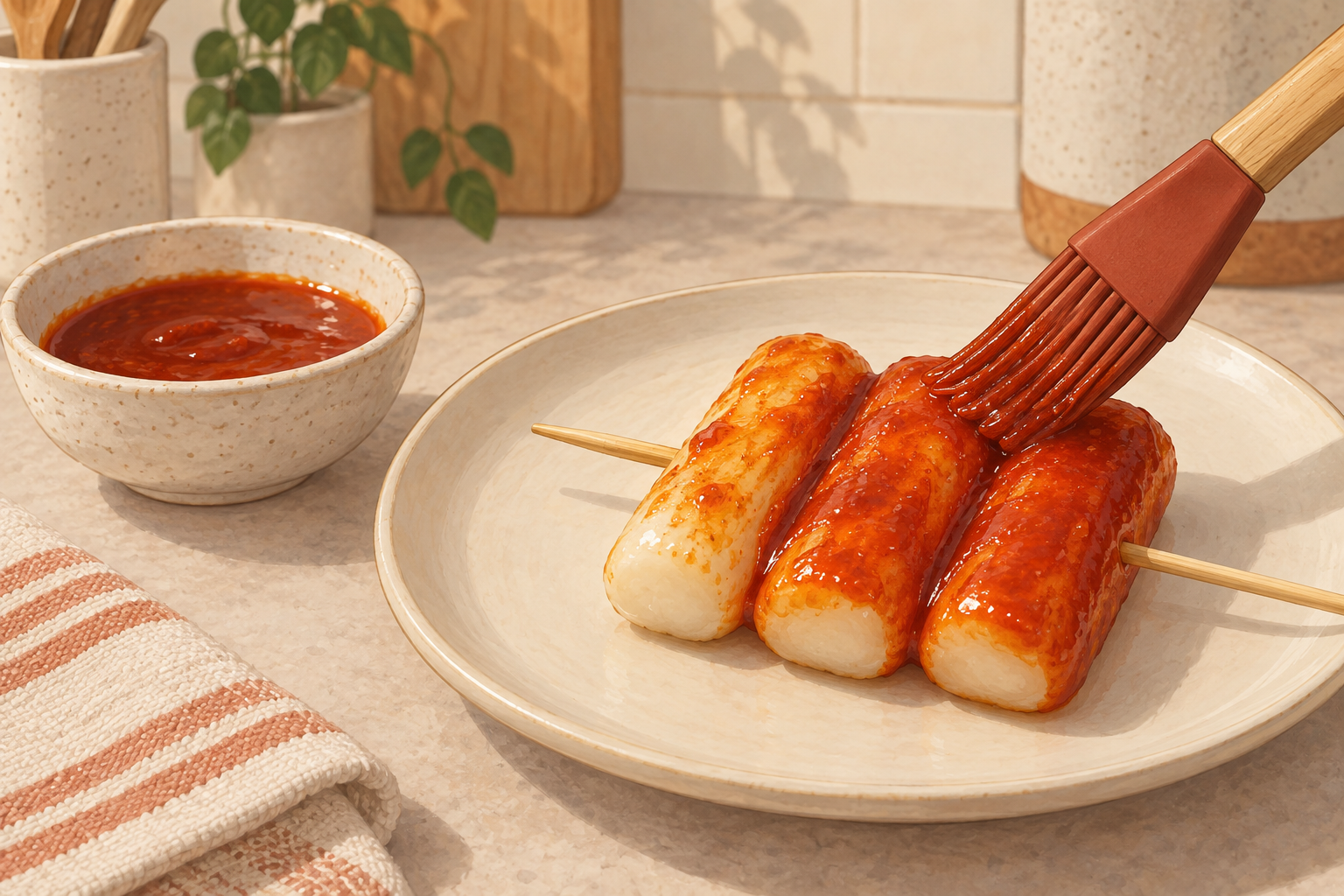
Transfer to a plate. Brush glaze onto both sides, then split into two snack portions. Serve while warm. Coating off the burner keeps the sugary glaze out of the frying stage.
Before buying: form, labels and the remaining pack
A product listing can establish a package size without revealing enough to choose safely for every diet. Check the actual rice-cake and condiment labels for ingredients, allergens, storage and preparation directions. We did not verify the complete back labels of the example products. Do not assume that a rice-based food is gluten-free: check gochujang in particular for wheat and soy, plus each package's cross-contact information. There is no nut garnish in this adaptation, but that does not certify a nut-free meal.
For an easier shopping decision, buy plain cylinders rather than a meal kit with its own sauce. If your pack contains a sauce sachet, do not count that sachet's weight as plain rice-cake weight. Keep the remaining uncooked portion under the package's stated storage conditions; the cooked-leftover advice below does not replace the manufacturer's instructions for an opened pack.
A 500 g package leaves 273 g after weighing this recipe's 227 g. Label that remainder with its opening date and plan its use from the package directions. There is no need to finish a pack merely to match the illustration's skewer count.
US shopping example and honest cost math
The following is a September 25, 2026 USD online observation, not an LA shelf quote or a checkout promise. H Mart lists Hansang Tteokbokki Rice Cake, SKU 9587, as a 500 g / 1.1 lb refrigerated pack at $2.99. No ZIP code or store inventory was selected. Delivery, availability and final price vary by location; check your own address before ordering.
| Purchase | Full-pack outlay observed | Amount used here | Allocated ingredient cost |
|---|---|---|---|
| Hansang rice cakes, 500 g | $2.99 | 227 g | About $1.36 for the rice cakes only |
| Oil, gochujang, ketchup, garlic, jam and honey | Prices and pack sizes not checked | See ingredient table | Unknown |
The arithmetic is $2.99 × 227 ÷ 500 = $1.35746, rounded to $1.36. Dividing the unrounded figure by two gives about $0.68 of rice cakes per snack serving. The remaining rice cakes represent about $1.63 of the observed pack price. These are allocated ingredient costs, not what the cashier charges for a partial pack.
Full shopping basket: unknown. Total recipe-used cost: unknown. Total cost per serving: unknown. The six other purchased ingredients are unpriced. Pantry ingredients are not assumed free. Tax, delivery, shipping and tips are excluded. The $2.99 figure buys the full rice-cake pack, and neither $1.36 nor $0.68 is a complete snack price.
For an LA store example, H Mart's official LA Madang store page lists 621 S Western Ave, Los Angeles, CA 90005, checked September 25, 2026. This verifies the location, not this product's stock or shelf price. Readers elsewhere in the US can use the official store finder and compare local Asian-grocery options; nationwide readership does not mean nationwide delivery coverage.
If a checkpoint goes wrong
| What you notice | Next action |
|---|---|
| A cake splits as you start the skewer | Stop forcing it. Return hard cakes to the softening stage; dry again before pan cooking. |
| Water is visible on the cakes | Blot again before adding to oil. Never use the pan to dry wet cakes. |
| The outside darkens very quickly | Reduce the heat. The clock is a starting point; dark char is not the target. |
| Cakes touch and stick together | Leave gaps between skewers and cook fewer at once. |
| The glaze catches or smells burnt | Stop heating and remake it; do not scrape burnt material onto the food. |
These are method-based troubleshooting suggestions, not results from a KoreanESY cooking trial. Do not use the pictures to judge whether a center is soft: check the actual food.
Leftovers and reheating
USDA's general leftover guidance says to refrigerate within two hours, or one hour above 90°F / 32°C. Use shallow containers and a refrigerator at 40°F / 4°C or below; do not leave food out waiting for it to cool completely. Refrigerated leftovers should be used within 3–4 days and reheated to 165°F / 74°C, checked with a food thermometer. This is general safety guidance, not a tested promise about the texture of this recipe. Reheated rice cakes may not keep their freshly cooked texture.
Try a short Korean conversation
Ask about a song or name a dish in Korean with original polite dialogues, a short exercise and suggested answers.
References
- Netflix Tudum — KPop Demon Hunters food guide, dated December 5, 2025; checked September 23, 2026. Supports the film-food connection, not a current popularity claim.
- Holly Ford, Beyond Kimchee — Rice Cake Skewers, checked September 25, 2026. Ingredient proportions, four-person source yield and medium-heat pan method; our half-batch choices and omissions are disclosed above.
- Sue, My Korean Kitchen — Korean Rice Cake Skewers, checked September 25, 2026. Supports the initial softening check, rinsing and drying, and glazing after pan cooking. Actual softening time depends on the pack.
- H Mart — Hansang 500 g rice cakes and LA Madang store, checked September 25, 2026. Listing size/price and store address only; full labels, local stock and checkout price remain unverified.
- USDA FSIS — Leftovers and Food Safety, checked September 25, 2026. General cooked-leftover storage and reheating guidance.
Keep going
Ready for a guided next step?
The learning path walks you through the key ideas, one comfortable step at a time.